Welcome back to Chant Works, a series taking on the nuts and bolts of the Carpathian plain chant (prostopinije) tradition. This week, we will take a look at the melodies in Tone 3, beginning with the troparion melody.
The Tone 3 Troparion melody in the 1906 Prostopinije
In the Tserkovnoje Prostopinije or “Church Plain Chant” of Bokšai and Malinič, here is the troparion of the Resurrection (the Sunday troparion) in Tone 3:
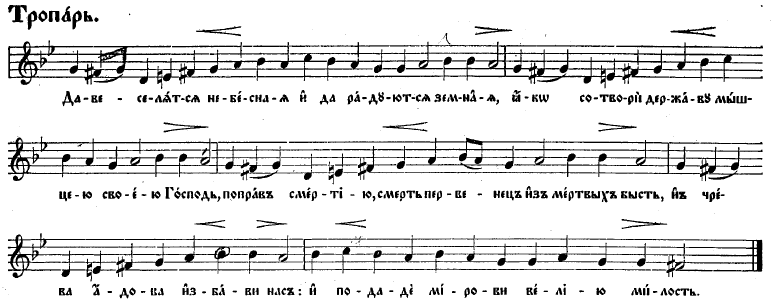
Note that the second and third notes are actually quarter notes, and a previous owner of this copy of the chant book changed them to eighth notes : )
First, you can see that the first and second are almost identical in form; the third is a little shorter. The fourth phrase is quite short, and the final phrase is different from the others and serves as a conclusion.
Second, this music has accidentals – marks that raise the pitch by a half step (sharp signs, #) or cancel a preceding sharp sign or one in the key signature (natural signs, ♮). That is because this chant is notated in a minor scale or minor key. (Find out more about major and minor keys here). The easiest way to explain the difference is that if the scale is based on do (do re mi) then it is a major scale, and it is based on la (la ti do) then it is some sort of minor scale.
In any case – the chant consists of a repeating phrase (used as many times as necessary) and a final phrase. Here is the repeating phrase:

That first phrase looks really hard at the beginning, even if we put in the solfege syllables:

But in reality this sounds exactly the sane as:

Once to you get this far, just reset to thinking of the last note as la, and keep going! Practice it this way a couple of times; if you’re still having trouble, there’s a more complete explanation here.
At the very end we sing the final phrase:

The Tone 3 troparion melody is slightly trickier than the ones in Tones 1 and 2, but not that hard overall.
The Tone 3 troparion in English
On the other hand, here is the first official setting of the Tone 3 Sunday troparion in English; this is from Byzantine Liturgical Chant (1970).
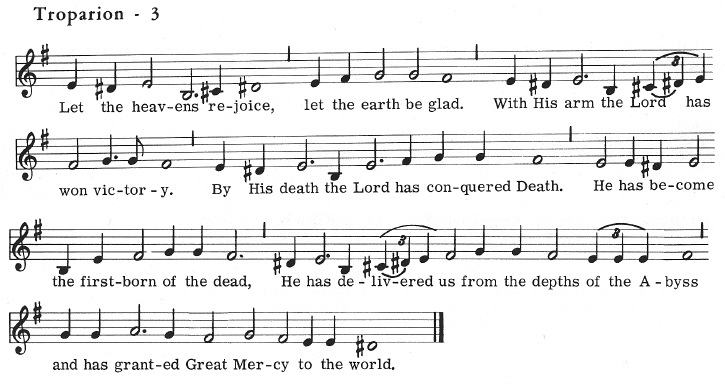
As in the other initial “official” settings in English, the repeating melody is adapted differently every single time. As a result, cantors often developed their own versions, or simply memorized the troparion from a recording.
Here, by contrast is the setting done by the Inter-Eparchial Music Commission, and included in the 2006 Divine Liturgies book:

To my mind, this is one of the better reworkings of the Slavonic melodies that was done by the Music Commission. By adding the option to repeat the first note, and putting consistent accents on the F# (HEAvens), Bb (LET), and A (EARTH), we end up with a pattern melody than can be adapted fairly easily to almost any texts.
As you’ve probably seen in previous Chant Works episodes, I am not above criticizing particular aspects of our current official settings, in order to learn from them. But this one is very singable. Admittedly, the accents on those rising quarter notes do move around, and I think it might have been a little easier to sing if the next to last phrase has been scored like this:

But that’s a small quibble. Note that none of these texts phrases are long; if they were, one could use the optional text phrase above in the Slavonic, or add a reciting tone on G (the fourth note from the end).
More Tone 3 troparia: Apostle(s)
There are quite a few troparia in Tone 3 in the menaia (service books for the year), but only two more in our Divine Liturgies book. One is the troparion for several apostles:

and the other is for a single apostle:

Both are in the “commons of saints” at the back of the book. The second one, for a single apostle, shows the limits of providing “generic” troparia where a name needs to be filled in. There are three notes over the saint’s name, so “Barnabas”, for example, works perfectly and sings well.
On the other hand, if the saint’s name has two syllables, you are better off dropping that third note:

While if the saint’s name has ONE syllable, you may be better of skipping the slurred note on “Apostle” and using the short form in the Slavonic:

It’s also worth noting that the pattern of accents in the last phrase (“that he may grant our souls forgiveness of sins”) has the accepts in slightly different places than in the Sunday troparion. What is we were to do the following, in order to emphasize “grant” and “souls”?

(The repeated notes – the fifth through seventh – are used in the other Tone 3 troparion setting in the 1906 Prostopinije, for “The Lord is God” as Matins.)
The takeaway here is simply that as one sets a text to a prostopinije melody, it’s good to know the common variations, and how to make use of them. As long as congregations hear the current note the cantor is singing and can guess where the next will be, they will sing along.