Welcome to Chant Works, a series on the inner workings of the prostopinije or Carpathian chant tradition. This week, we’re looking at the basic melodies in Tone 3 that are used at the Divine Liturgy.
For Tones 1 and 2, I mentioned that the troparion melody is also used for singing the short hymns called kontakia. With Tone 3, the plot thickens.
Troparia, kontakia, and how to sing them
In the Byzantine liturgical tradition, every day has its own troparion, a short hymn that encapsulates the theme of the day. This hymn is sung at the end of Vespers, repeated at the beginning of Matins, and sung once more at the Gospel entrance (Little Entrance) of the Divine Liturgy, or Eucharist.
The kontakion is another “hymn for the day.” It is the remaining stub of a long liturgical poem, also called “kontakion,” from the kontax or around which a scroll with the poem was originally wound. Today, the first stanza of the original kontakion, along with the second stanza called an ikos (“house” or “foundation”), is sung in the middle of the canon at Matins, and then sung again at the Little Entrance of the Divine Liturgy.
So the troparion and kontakion together serve as a thread that winds through the liturgical services of any given day; they are also sung at the lesser services such as the Hours. If several saints are celebrated on a given day, there will usually be a troparion and kontakion for each; and there are series of troparia and kontakion in honor of the Resurrection, in all eight tones, forming an 8-week cycle.
Now, in the Slavic Byzantine liturgical tradition, the melodies used for singing troparia and kontakia arrived rather late on the scene (for reasons we may delve into later). Some of these seem to be associated in particular with the southern Slavs, and may come via Serbia or Bulgaria.
In the prostopinije tradition today we have a complete set of eight troparion melodies, one in each tone, and easily adapted to various texts. These same melodies are also used for singing “sessional hymns” (hymns sung at Matins while sitting, after sections of psalmody); there are also special melodies for sessional hymns, identified by their tone and the first words.
And THAT is where our story gets interesting. At some point, special melodies for particular feasts seem to have become SO popular that they ended up being used not just for the feast-day kontakia they were written for, but for ALL kontakia in the same tone. And the first of these happens to be Tone 3:
Kontakion of the Nativity, Tone 3. Today, the Virgin gives birth to the Transcendent One, * and the earth offers a cave to the Unapproachable. * The angels sing his glory with the shepherds; * the wise men journey with the star. * The eternal God is born for us as an infant child.
The Tone 3 kontakion melody in the 1906 Prostopinije
In the Tserkovnoje Prostopinije or “Church Plain Chant” of Bokšai and Malinič, the Tone 3 kontakion melody occurs in the Eight Tones section, with the text of the kontakion of the Resurrection in Tone 3:
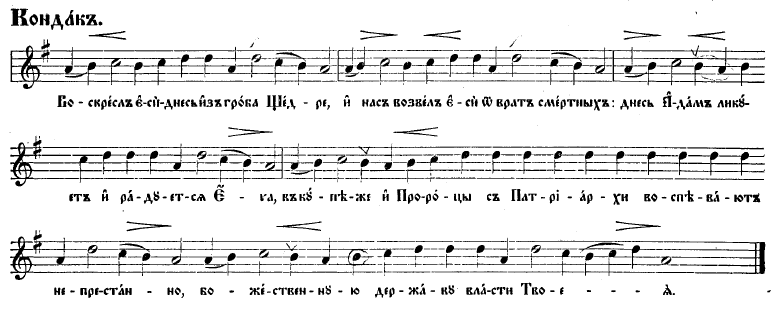
This melody consists of a single, rather lovely repeated phrase, with a slightly altered conclusion which is used at the VERY end of the hymn as a sort of signal: NOW we are done. Here is the repeated phrase:

Notice that it begins and ends on the same note, and in fact the ending is just the beginning but in reverse. It has three notable accents:
- An initial accent, on do, which marks the middle of the opening section, the intonation.
- An accent at the start of the reciting tone, the note on which any amount of text can be sung.
- An accent at the start of the cadence (concluding formula). Notice that the reciting tone is separated from the cadence by a preparatory note which signals that we are about to go into the cadence. Since the cadence begins with an accent, the preparatory note is almost always “weak”, or UNaccented.
Here is the same phrase, with the parts marked:

And the last time through, the cadence has TWO accents, and a slight turn in the melody that says, NOW we are done:

Why am I making such a big deal about parts, and accents, and such? I’m glad you asked, because it’s all about the genius of our particular tradition of plain chant: it can be used to sing practically ANY hymn, without (much) need for written music. Here’s how it works.
Chanting from a pure text
One of the ways old-school cantors were taught to chant was by being required to sing any text – for example, a psalm, or the Gettysburg Address* – in any tone, and using any special melody. This is because our liturgical books in the 19th century provided the people with JUST the texts of the hymns, and the name of the melody to be used. The rest was up to the cantor, who had to know the melodies and be able to sing them “cold” – and yet, the people could sing right along, as long as they had learned the basics of the melody and could hear the cantor well enough to follow him or her.
(* One of my cantor students recalls that in her childhood, her mother and her aunt, both of whom knew the chant, would have her and her sisters sing paragraphs from the day’s evening newspaper, after calling out the tone to use.)
It turns out that the Tone 3 kontakion melody is an excellent guide to see how this works. Recall what the repeating phrase looks like:
Suppose we want to sing the Sunday kontakion in Tone 3 to this melody:
Today you arose from the grave, O merciful Lord; you led us out of the gates of death. Today, Adam exults and Eve rejoices. With them, the prophets and patriarchs ever praise the might of your divine power.
We start by dividing the texts into pieces – not too short, not too long – with each part having some internal connection; that is, don’t separate related words. By tradition, we mark the divisions with asterisks (*). Here is how this hymn might have looked in the old Velikij Sbornik or Great Anthology (though there it would have been, or course, in Church Slavonic.)
Today you arose from the grave, O merciful Lord; * you led us out of the gates of death. * Today, Adam exults and Eve rejoices. * With them, the prophets and patriarchs ever praise the might of your divine power.
(There ARE different ways you could divide the hymn up; start with one that looks right, and adjust later if you need to.)
Let’s look at just the first phrase, and mark the accents:
Todáy, you aróse from the gráve, O mérciful Lórd
Notice that the last syllable (“Lord”) is accented. But in prostopinije, the last syllable almost always lands on the last note, so we usually don’t pay much attention to whether it’s accented or not. Instead, we look for the last internal accent – that is, the last accent that is NOT the final syllable. And rather than always saying “last internal accent”, I am going to just call it the lia. (You’ll see why in a minute, I promise!)
Similarly, many (not all) prostopinije phrases have an intonation that leads into the reciting tone, and the reciting tone starts on an accent. So we are also going to look for the FIRST internal accent – that is, the first accented syllable that is NOT the first syllable. Let’s call it the fia. (Sometimes that is all we need; but for other melodies, we will look for the second and third internal accents, which we will call sia and tia, though this sounds like we are in a roomful of aunts.)
Rule for Slavic chant (from Vlad Morosan, Choral Performance in Pre-Revolutionary Russia): Each chant phrase moves from the beginning, to the first internal accent (the fia), to the final internal accent (the lia), and then to the end.
And miracle of miracles, this is exactly how MOST prostopinije phrases actually work:
- If the intonation has an accent in the middle, then the fia syllable goes on this accent, and the sia goes onto the reciting tone.
- If the the intonation has no accent, then everything up to the fia makes up the intonation, and the fia is the start of the reciting tone.
- The lia goes on the accent that starts the cadence. (If the cadence is long, we may have to look at the last two or three internal accents to make it come out.)
It’s time for an example! Here’s the first phrase of our kontakion:

The fia “-day” goes on the accent in the middle of the intonation, and the sia “-rose” falls on the reciting tone. The lia “mer-” starts the cadence, and there are three syllables after it, exactly matching the three remaining notes. (The unaccented syllable “O” goes to the preparatory note for the cadence.)
When we sing, there will usually be a SLIGHT crescendo (increase in volume) from the beginning to the first accent, then back off a little, then crescendo again to the start of the the reciting tone. Aim for “merciful”, and slightly decrease the sound over the last three notes. If you look in the 1906 Prostopinije, this way of doing things closely matches the bulk of the dynamic (loudness) markings.
Here’s the next phrase:

There is only one syllable before the fia, so it is sung over the first two notes, which are slurred together. The same thing happens with the word “us” just before the reciting tone, and the word “of” in the cadence. Where the accents fall affects how which notes are slurred together.
Here is the third phrase:

The word “Adam” starts with an accent, but it comes right after the accented “todáy.” If we soft-pedal the accent on Adam, this gives us THREE syllables in the second part of the intonation, so we repeat the first note (the F#), singing “Adam” on a single pitch. Since there is only one syllable after the fia, and that final syllable goes on the last note, the fia acquires the first three notes of the cadence, slurred together.
Here is the fourth and final phrase. No surprises here, except for the longer ending cadence which has TWO accents, as we saw above. Since there are two text accents in a row, this works out nicely.
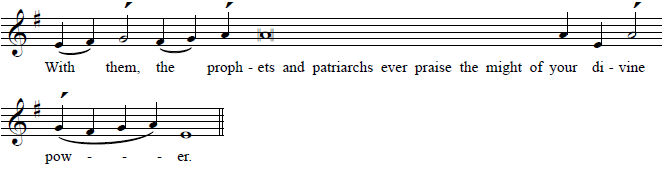
Now, this final phrase is rather long, so a cantor setting it from scratch could have divided it in two: “With thém, the próphets and pátriarchs * ever práise the míght of your divíne pówer.” See if you can sing it that way!
Glory!
I mentioned earlier that the troparion AND the kontakion of the day are sung at the Gospel entrance of the Divine Liturgy. When this happens, we sing “Glory to the Father and to the Son and to the Holy Spirit, now and ever and forever. Amen.” before the kontakion. If there are two kontakia, we sing “Glory to the Father and the to the Son and to the Holy Spirit” before the first one, and “Now and ever and forever. Amen.” before the second one.
What melody do we use? Ah, that’s easy. We sing Glory… now and ever (or Glory… and Now and ever…. separately) to the melody of the hymn that follows.
That is why the music for Glory.. .now and ever is provided in the Eight Tones section of our Divine Liturgies book, using the kontakion melody in each tone. Here is Glory… now and ever… to the Tone 3 kontakion melody:

I would encourage you to go through the exact same procedure we used above, phrase by phrase: find the intonation, reciting tone, cadence, fia and lia, and so on.
If you do, you may very well ask: “Wait a second. The words ‘to’ and ‘and’ aren’t accented. Why on earth are we singing them here as if they are?”
The answer to that question is that, in English, we tend to group syllables in two’s and three’s, each group of syllables starting with an accent. “Secondary accents” start appearing any time we go more than two syllables after an accent without another “real” accent. Like so:
Glóry to the Fáther and tó the Són and tó the Hóly Spírit, nów and éver ánd foréver. Amén.
Some of these accents will be slightly stronger than others, depending on the sounds of the words, the length of the vowels, and so on. But these accents CAN be used when singing, as long as we don’t go overboard.
Now go back and take and look at “and forever. Amen.” Here we DON’T have two consecutive accents near the end of the melody, so we split the half note into two quarter notes in order to sing “EVER” so them. Splitting a note like this is not is not uncommon.
The Divine Liturgies book also shows how Glory.. and Now and ever… are sung separately.


At the end of the Glory…, combining the two accents of the cadence (what I will elsewhere call a “bridged accent”) is an alternative to splitting the half note into quarter notes, as is done in the Now and ever.
The Tone 3 kontakion melody in English
It will be no surprise to readers of Chant Works that the first official setting of this melody, in the 1970 collection, Byzantine Liturgical Chant, was somewhat simplified and “prettied up.” Here it is, preceded by the Glory… now and ever.
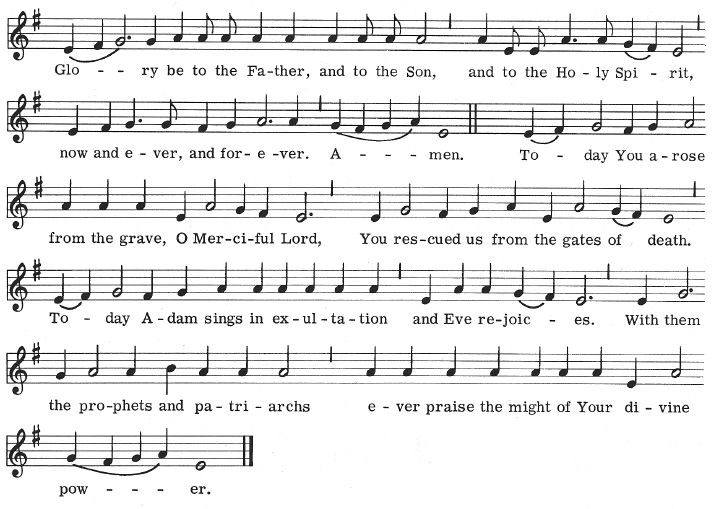
The even quarter note rhythm in the Slavonic is abandoned in the Glory… now and ever, but returns in the hymn. The intonation is shortened, often omitting the middle note of the first part or the entire second part. Still, of the settings in the collection, this one is closer than most to the Slavonic.
Two “cantorisms” should be noted. At the very beginning, the melody line goes directly to the reciting tone from the accent in the middle of the intonation. In all likelihood, this started as a tenor harmony, and we will encounter it again. And early in the sixth line we see on “and” the same sort of raised note we saw in the Tone 2 troparion melody.
Here is the same kontakion in the 2006 Divine Liturgies book:

And finally, we return to where we started: the feast-day kontakion of the Nativity of the Lord, which is probably the origin of this melody.

You can find more examples of the Tone 3 kontakion melody here; there are seventeen Tone 3 kontakia in the Divine Liturgies book!
I know this has been a VERY long post – I hope it was helpful! Please feel free to leave comments below. I would be curious to know your thoughts after looking through the examples linked just above.