The Tone 3 prostopinije melody for prokeimena and Alleluia is one of the easiest, so this week we will take a quick look at it, and also discover why mi mi mi can give cantors heartburn.
The Tone 3 prokeimenon melody in the 1906 Prostopinije
Here are the Sunday prokeimenon and Alleluia from the 1906 Tserkovnoje Prostopinije or “Church Plain Chant” of Bokšai and Malinič:
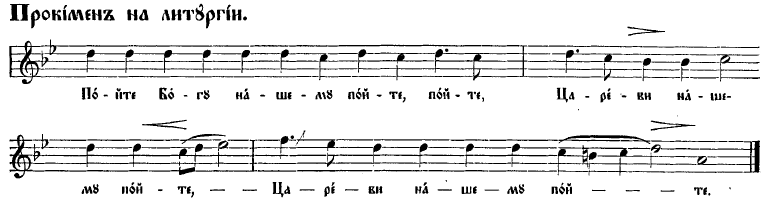
(The audio here is a recording by Fr Petraševič, made in Czechoslovakia during the Prague Spring, when restrictions on the Church were temporarily lifted.)

We’ve noted before that the prokeimenon melody in prostopinije, which is also used for the Alleluia, is generally in three parts. But here, much of the initial phrase of the prokeimenon is omitted in the Alleluia, running straight into the second phrase; the final phrase of each is identical.
Overall, it is a simple scalewise melody, until the jump down to the final note – but it begins on the third degree of the scale, or mi, which is sometimes hard for cantors to hit squarely. When singing mi, one should generally think “high” to avoid going flat. The only accidental occurs in the last phrase, there the natural sign raises do by a half step, and temporarily prevents us from landing on the tonic. (We saw the same thing happen in the Tone 2 prokeimenon melody.)
The Tone 3 prokeimenon melody in English
Here are the first official settings of the Tone 3 prokeimenon and Alleluia in English, from 1970 collection Byzantine Liturgical Chant:
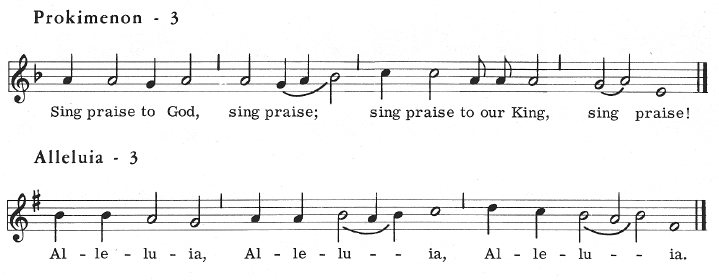
They have a family resemblance to the Slavonic version, but their resemblance to each other is somewhat hidden by the fact that they are notated in different keys!
Here are the settings from our 2006 Divine Liturgies book:


Neither of these pieces of notated music shows how the psalm verses are to be sung; normally we employ the ordinary psalm tone (do / re ti do). So from the end of the prokeimenon or Alleluia, go UP a half step to start the psalm verse; and when it ends, go UP a major third (to mi) to repeat the prokeimenon or Alleluia.
Here’s the cheat sheet for the prokeimenon, then the one for the Alleluia:


Remember to think “high” when singing mi at the start of the repeat of the prokeimenon or Alleluia, so you don’t go flat!
You can find more Tone 3 prokeimena and Alleluia to practice on here.
One more thing…
When we looked at Tones 1 and 2, I mentioned that the prokeimenon melody is also used for singing “Let everything that lives and that breathes” and “Holy is the Lord” at Matins.
But Tone 3 is a strange exception: here we sing those hymns, AND the prokeimenon of Matins, to the Tone 3 samohlasen instead. (We will cover the samohlasen melodies later this year in Chant Works.)
Ah, the wild and wooly ways of prostopinije…