With Tone 6, we return to the exciting world of separate prostopinije melodies for troparia and kontakia – but in this case the two are rather similar. Let’s look first at the troparion melody in Tone 6.
The Tone 6 Troparion melody in the Slavonic sources
The 1906 collection Tserkovnoje Prostopinije (“Church Plain Chant”) is our basic source for prostopinije melodies, but as we will see, sometimes we need to look at additional sources as well to understand how we got to where we are today.
Here is the troparion of the Resurrection (the Sunday troparion) in Tone 5, taken from the 1906 Prostopinije:
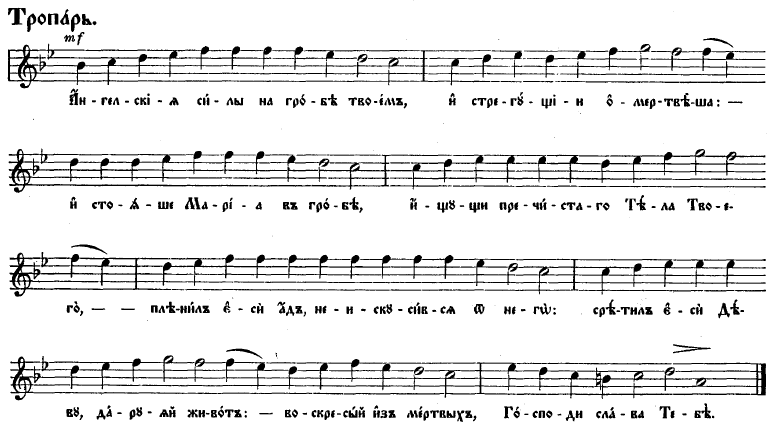
We can see that the melody is made up of three kind of phrases: an opening melody that rises scalewise (do re mi fa so) to the reciting tone, and concludes with two half notes; a second phrase this is also scalewise but changes direction, and then ends with two half notes and a slurred pair of quarter notes, giving a sort of “limp”; and finally a concluding phrase with di (avoiding the tonic) following by three longer notes. The whole melody ends, as we see so often in prostopinije, on the unstable note ti.
Because of the half notes, this is a steadily “duple” melody; you can count out the whole troparion as 1-and-2-and, with only very occasional added beat. There is no real triple rhythm throughout.
On the other hand, you can see that the accented syllables in the Slavonic text often fall on weak notes, such as the B natural near the end of the last line. Now in both prostopinije and Gregorian chant, this sort of thing is not uncommon: the cantor is supposed to sing in a way that makes the accents somewhat noticeable, but we don’t always bang out the text accents full force. This has sometimes led to the accusation (especially from Great Russians – that is, those in the Moscow or Novgorod singing tradition) – that prostopinije cantors “ignore accents.”
Sometimes this claims hit too close to home. This may be why Father Stefan Papp, who edited a new edition of the Irmologion in Prešov, (Czecho)slovakia in 1970, “corrected” the accents – most notably in the Tone 6 troparion melody. Here is Father Papp’s version:
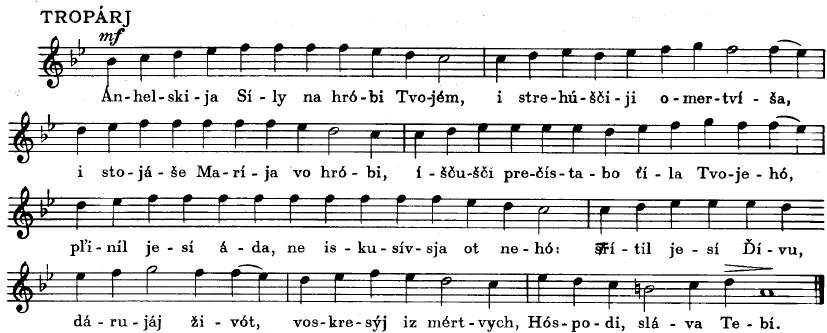
Notice that the first alternating phrase (the A phrase) now ends with a quarter note and half note, or vice versa, instead of two half notes, while the “limping” end of the B phrase is a little different each time: quarter, half, two quarters; four quarter notes; half, quarter, two quarters. Finally, the ending phrase changes the weak preparatory B natural (di) to an accented note so ensure that one sings SLAva teBI instead of “slaVA TEBI.”
The Tone 6 troparion melody in English
As a matter of fact, there are not THAT many troparia in Tone 6, but the ones we have are important, beginning with the Sunday troparion. Here is the troparion of the Resurrection in Tone 6, as it appeared in the first official collection of English music for the Eight Tones, Byzantine Liturgical Chant (1970):
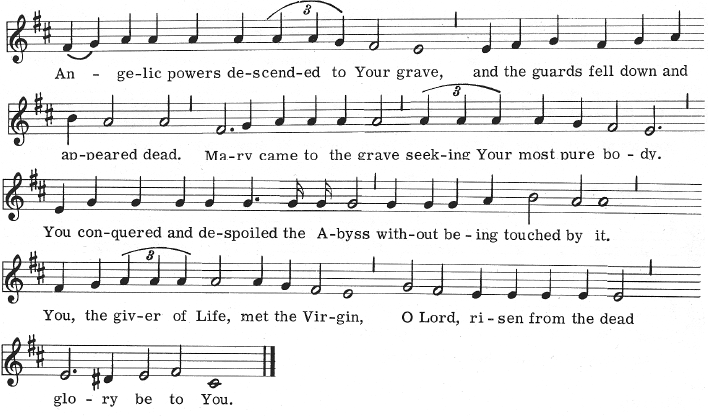
The first two notes (the do and re) which only occur at the beginning in Slavonic are dropped, the the rhythm is “jazzed up”, with triplets and even sixteenth notes. The A phrase ends with two longer notes and the ending rhythm from the 1906 Prostopinije is visible, though the “limping” ending of the B phrase is gone.
That ending was restored, and the rhythm smoothed out, in the 2006 Divine Liturgy book. But that version also shows the unmistakable influence of the 1970 Irmologion:

The distinctive opening (do re mi fa so, all the same length) has been restored, along with the “limping” ending in the B phrase. But the A phrase ends sometimes with one half note and sometimes two, making that triple rhythms abound in this setting – a very UNcharacteristic sound for prostopinije.
In fact, the Papp ending (SLAva teBI) was also used in early settings of this melody that made it into some publications of the Metropolitan Cantor Institute, before widespread cantor pushback led to changes. Still, the two half notes right before the final whole note remain shortened to quarter notes. As a result, I hear more student mistakes when singing this melody than for any of the other troparion melodies.
There is also a rhetorical rhythm: the B phrase is usually an answer to the A phrase, even if the limping rhythm that ends the B phrase makes it preferable to move right into the next phrase without a pause. In your look at the Sunday troparion, each B phrase “answers” an A phrase, except for “You the Giver of Life / met the Virgin.” Here, there is no real contrast before the two parts, just a continuation.
If we were doing this from scratch, I would probably propose singing it like this:
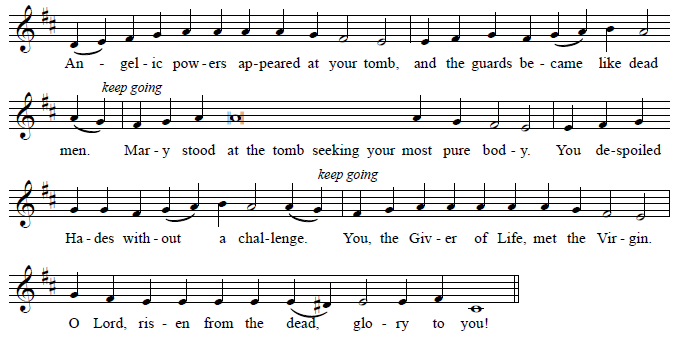
This restores the consistent double-half-note to the end of the A phrase, and reorganizes the last few phrases, emphasizing “met” and “risen” in the process.
The troparia “for any need”
I mentioned above that there are very few Tone 6 troparia. Besides the Sunday Troparion in Tone 6, there is a troparion for Saint Theophylact on March 6, and the responsorial troparia at Vespers with Divine Liturgy on Christmas Eve. (In a future installment of Chant Works, I’ll explain why I think we ought to be using a different melody entirely for these.)
But there is one more use of this melody: namely, the troparia “for any need” or “for a general intention.” These three hymns – two troparia and a theotokion – appear in the 1906 Prostopinije as part of the music for Compline, and in the 2006 Divine Liturgies book as part of the General Moleben (pages 444-445):
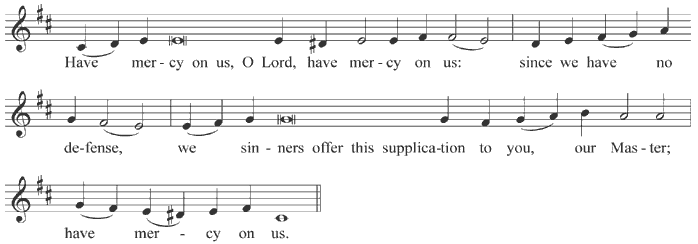
The beginning of the first troparion is rather odd, in both Slavonic and English: it is really the beginning of the Tone 6 samohlasen melody, under a thin disguise. (We will discuss samohlasen melodies in a future series in Chant Works.) Then it settles down to the regular Tone 6 troparion melody, from the do re mi fa so beginning to the end. In Slavonic, the match is quite close, while in English the limping ending is missing.
The second troparion in English mostly omits the double-half-note ending in the A phrase, while adding back the limping ending in the B phrase. There are triple-rhythm passages from beginning to end.

The third troparion, or theotokion (hymn to the Mother of God) returns to duple, restores the double half note ending, keeps the limping B phrase ending, AND restores the half notes at the very end of the melody!
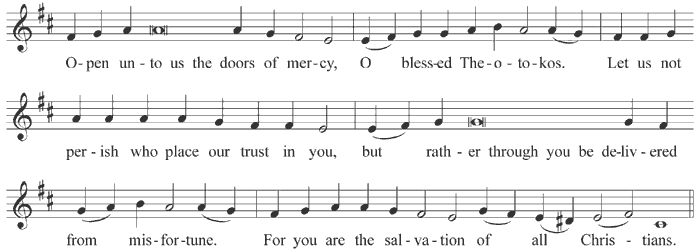
To my ear, this is the best setting of the three. But because it departs from the Sunday troparion in Tone 6 AND the previous two troparia, it doesn’t have much influence. In general, cantors have a lot of trouble with these troparia, and in an ideal world, we would re-set them in future Compline or moleben books.
Tone 6 does have its own kontakion melody. Onward!