We’ve seen that Tones 3 and 4 have their own special kontakion melodies in the prostopinije tradition (the other tones just use the troparion melodies). This week’s Tone, Tone 6, is another – and the Tone 6 kontakion melody is one of the easiest to sing in the prostopinije Eight Tones stable.
The Tone 6 kontakion melody in the 1906 Prostopinije
The first section of the Tserkovnoje Prostopinije of Bokšai and Malinič provides basic examples for all our eight-tones melodies, including the troparion and kontakion of the Resurrection, used on Sundays and in the Paschal season. Here is the kontakion of the Resurrection in Tone 6:
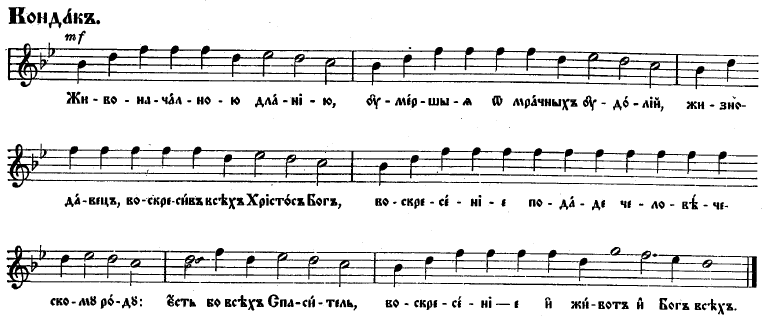
By now, even if you don’t read the Cyrillic alphabet, you can probably see at a glance what is happening here. The same musical phrase is repeated four times: three rising notes with skips in between, a reciting tone with a varying amount of text, a leap down to a quarter note, and then a three-half-note cadence. The phrase begins on do with a sort of trumpet call – do mi so – and ends on the unstable note re.
So using the terminology we developed earlier, we can summarize the repeating phrase this way:

Short and sweet. The preparatory note is almost always unaccented, since it prepares for the accent on the cadence. The next to last phrase above is a shortened form that that be better known than it is, and the very last phrase starts the cadence on the highest note in the whole troparion (la) before descending to the end:

The rhythm given here for the cadence is how we generally sing it in English, slightly simplified from the Slavonic.
The Tone 6 kontakion melody in English
Here is the melody as it appeared in the first official English setting of the eight tones, in the 1970 collection, Byzantine Liturgical Chant. It is preceded by the Glory… now and ever, which as we mentioned earlier is sung before the kontakion at the Divine Liturgy, using a short form of the same melody.
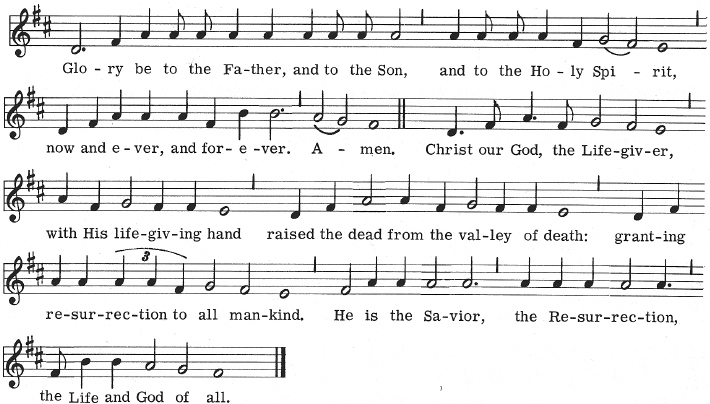
Admittedly, the rhythm here is again “jazzed up” quite a bit compared to the Slavonic, and the beginning of the final phrase leaves out the first note entirely. But if you look at “with His live-giving hand” and squint a bit, you can see the “short form” I mentioned above. If the text for a phrase begins with an accent or has only one accent in the middle, the short form might be the best way to sing it.
Here, for comparison, is the Sunday kontakion in the 2006 Divine Liturgies book:

It is certainly the same melody; in fact, when singing the text on the reciting pitch you WILL (or at least should) speed up and slow down the notes to match the accents in the text.
My one quibble with both of these settings is that the final phrase (“He is the Savior of all, the Resurrection, the Life, and the God of All”) is awfully long, and doesn’t really give the hearer or singer much time to take in all those title. If one were starting from scratch, one might do it this way instead:

This illustrates one point we’ve seen but not highlighted: if there are three syllables before the first internal accent, or fia, we sometimes repeat the first note, as we do here on “He is the Sav(ior)” in order to make the intonation fall nicely. This is something cantors learn to do instinctively when singing “from the book.”
Other kontakia in Tone 6
There are a number of Tone 6 kontakia in the 2006 Divine Liturgies book – eleven in all – and they include a number of important Sunday and special hymns (for Cheesefare Sunday, Palm Sunday, and the common theotokion “Steadfast Protection of Christians”). You can see and listen to them here.
Just as the kontakion melodies for Tone 3 and 4 probably originated as special melodies for Christmas (Tone 3, “Today the Virgin gives birth to the Transcendent One”) and Theophany (Tone 4, “You have revealed yourself to the world today”), the kontakion melody for Tone 4 probably originated as a special melody for Palm Sunday or the feast of the Ascension. Given that Tone 8’s special kontakion melody is that of Pascha, I would wager that the Tone 6 kontakion melody was originally for the Ascension, another great feast of the Lord:

Glory… now and ever…
Remember that at the Divine Liturgy, we sing “Glory to the Father and to the Son and to the Holy Spirit, now and ever and forever. Amen” before the kontakion, singing it to the same melody as the kontakion that follows immediately after. The music for this can be found in the Eight Tones section of the Divine Liturgy book, immediately before the Sunday kontakion. Here it is in Tone 6:

If there are TWO kontakia, we sing “Glory to the Father and to the Son and to the Holy Spirit” before the first kontakion, and “Now and ever and forever. Amen” before the second. Remember that they may be in different tones!
The music for Glory… and Now and ever… (separately) is found in the Eight Tones section of the Divine Liturgies book, immediately after the Sunday kontakion. Here they are in Tone 6:


Being able to sing these at the drop of a hat is an important skill for cantors, because they signal to the congregation if there will be a switch to a different tone for the next hymn. In general, the cantor sings these by himself or herself, though other cantors and the congregation will sometimes join in.