With Tone 5, we return to 3-part prokeimenon and Alleluia melodies – AND we can (even if only briefly) emulate the late, great Nat King Cole.
The Tone 5 prokeimenon and Alleluia in the 1906 Prostopinije
Here is the Sunday prokeimenon from the 1906 Tserkovnoje Prostopinije or “Church Plain Chant” of Bokšai and Malinič:
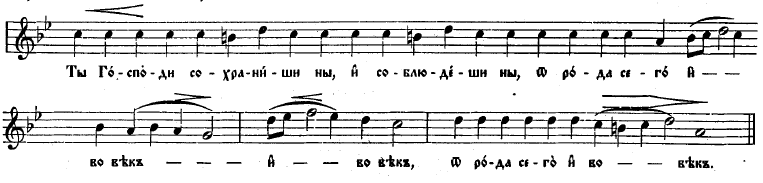
There are several points of interest here.
The prokeimenon opens with a long section chanted on a single note, broken up twice with the sequence re – di – mi – re, which sounds exactly like do – ti – re- do. If this sounds at all familiar, it might be because these are the opening notes of Nat King Cole’s Mona Lisa. That gets us ALMOST to the end of the first line of music.
The ending of the phrase is more elaborate, and has one of the few endings where a syllable is sung over several notes INCLUDING the last one. Notice also that the high note in the phrase is in the middle of a slur. The same thing happens in the second phrase: the high note does not start a new syllable, but comes in the middle of one.
The last phrase starts on a reciting tone and ends with a four note pattern with that raised note to avoid landing on do, and a conclusion on the unstable ti that leads right into the psalm verse.
The Alleluia is very similar – but it completely omits the opening reciting tone and the Mona Lisa pattern:

Look closely at the fourth, fifth, and sixth notes. Compared to the prokeimenon, the Alleluia adds a leap downward, then back up before continuing, while the rest of the Alleluia matches the prokeimenon fairly exactly.
The Tone 5 prokeimenon and Alleluia in English
Here is the first official setting of the Tone 4 Sunday prokeimenon in English, from 1970 collection Byzantine Liturgical Chant:
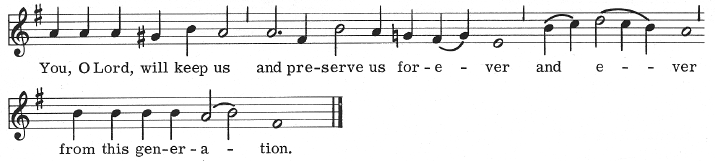
This simplifies the Slavonic by omitting notes. In the first phrase, it drops the rising notes in the middle of “preserve” and the final note of the four note pattern on “forever-“. In the final phrase, the four note pattern A – G – A – B is reduced to the first and last notes, A – B, sung as half notes.
The Alleluia was done a bit differently:

Here the first-phrase “drop” we mentioned above (notes 4 and 5) is kept, but the notes after it are cut out; and in the last phrase, the four quarter notes become two half notes only.
The initial setting of the Tone 5 prokeimenon and Alleluia by the Inter-Eparchial Music Commission was very close to the Slavonic, and a recording was included in a CD provided to Metropolitan Cantor Institute students as as Christmas gift around 2002. Here is the Alleluia:
I have heard second- or third-hand that this was one of the cases where the Council of Hierarchs asks for a slight simplification of the melody, and it is certainly true that the final version in the 2006 Divine Liturgies book is more singable and (to my mind) a good compromise between old and new.
Here is the final version of the Tone 5 prokeimenon in the Divine Liturgies book:

The opening reciting tone is there, with just one “Mona Lisa” pattern, and the drop is gone, but otherwise the melodic line of the Slavonic is on display.
The Alleluia omits the initial reciting tone, changes two eighth notes to quarter notes, and the rest matches:

With both, singing the psalm tone is easy: the prokeimenon or Alleluia ends on ti, so we just go a half-step up to sing the psalm verse; and when that ends on do, we go another step up to re to repeat the prokeimenon or Alleluia. Here is the cheat sheet:

Other prokeimena in Tone 5
There is only one other Tone 5 prokeimenon in the 2006 Divine Liturgies book: namely, the Vespers prokeimenon for Wednesday evening, which can be found in the Vigil Divine Liturgy section on page 120.

One could, of course, change the eighth notes at the start of the second phrase to quarter notes to match, but leaving them reminds us that this should be at least a little sprightly; besides, it puts a solid emphasis on “power.” Let it be, I say.