Anyone who regularly attends services in the Byzantine Rite has heard about the “eight tones.” These are eight sets of musical melodies, with their associated texts, which are assigned to successive weeks of the liturgical year, and also associated with particular hymns that fall on fixed days of the calendar.
In this first installment of Chant Works, we will take a closer look at the Tone 1 troparion melody in the prostopinije, or Carpathian plainchant, tradition used in the Byzantine (Ruthenian) Catholic Church in the United States.
The Eight Tones and Congregational Singing
In our churches, it has been customary for centuries that services are sung congregationally from beginning to end. Here is a description of church singing in the Carpathians between World Wars I and II by a Russian musicologist, Ivan Gardner:
The people chant from the Velikij Sbornik [Great Anthology], which contains all the necessary texts… The cantors – the more experienced chanters among the parishioners – who stood on the kleros, began the chanting. As soon as those present recognized the melody, the whole church sang: they sang all the stichera, all the troparia, all the irmoi – in a word, everything that the typikon indicated was to be sung. They sang in unison, and whoever was able added a parallel melody line or improvised a bass line. The impression produced was one of extraordinary power.
Beginning in the 1860’s, the people in our churches used books which provided all the texts for Vespers, Matins, and the Divine Liturgy. There was no musical notation; instead, each hymn was preceded by the tone number and the specific melody to use. These books ran to as many as 900 pages – far too much material to simply memorize. So how could the people sing it all?
The answer is rather straightforward. There are a limited number of prostopinije melodies in the eight tones – about 60 or 70, setting aside the more complicated hymns called irmosy – each of which can be adapted to any text. As we will see, the cantor has a “model” in his (or her) head of how the music goes, phrase by phrase. The people also have a model of the music (hopefully the same one!) from having listened and sung each melody in the past, and once they hear the cantor they follow his or her singing, listening almost by reflex for the places where the music may change, to see which of several options the cantor may choose. At any given moment, there are a limited number of places the cantor can go next, and this is what makes the chant system “work.”
There are almost always several “good” ways to sing any particular chant (and here by “chant” I mean a liturgical test together with a particular melody for it). A “good” chant is one that worthily clothes the liturgical text with music, and does so without awkwardness or surprises, so that the congregational can sing it comfortably along with the cantor in order to concentrate on the prayers and praise they are singing.
Now, when Byzantine Christian texts and music in Greek were brought northward to the lands of the Rus’, the people there (after experimenting with trying to sing in their own language to the exact same Greek melodies) wrote their own music for the major hymns, and created melodies for the rest that could be expanded or contracted to fit any text. A complete set of these melodies has come down to us as the prostopinije tradition.
In this series, we will start by looking at the melodies in the Eight Tones that are used for singing the hymns we call troparia, kontakia, and prokeimena.
The Tone 1 troparion in the 1906 Prostopinije
As Gardner notes, the people in our churches in Europe first sang from books without music. The most difficult melodies were passed down in handwritten or printed books called Irmologia, while the more ordinary melodies were part of the common fund of each region’s church culture, learned by listening.
So it was not until 1906 that most of the prostopinije melodies were collected into a printed book, the Tserkovnoje Prostopinije or “Church Plain Chant” of Ioann Bokšai and Iosif Malinič. This collection has since been reprinted and expanded, but remains our basic printed source for chant in the prostopinije tradition.
The 1906 Prostopinije begins with the melodies in the Eight Tones, from Tone 1 to Tone 8, and the Tone 1 troparion melody is given in two variants: first a “short form” for singing The Lord is God at the start of Matins, and then the troparion of the Resurrection in Tone 1, which is sung at Vespers, Matins, and the Divine Liturgy every eight weeks. Here is the Sunday troparion in Tone 1:
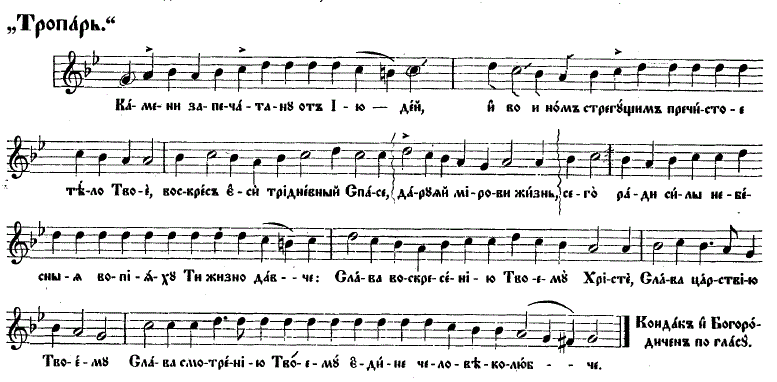
The text is in Church Slavonic. (Don’t worry if you can’t read the Cyrillic alphabet.) But even a quick glance shows this is not a particularly easy melody to understand. In fact, it’s one of the more difficult troparion melodies, but for exactly that reason it’s a good starting place.
Chant scholar Myroslaw Antonowycz noted that Father Bokšai’s version of this melody is “rather improvisational.” At the same time, it would be just as correct to say that the musical engraving for the first page of the 1906 Prostopinije in Church Slavonic has mistakes, including some bar lines which are in the wrong place. We can see this by comparing it with later chant books, and also in marginal corrections like this one above:

The Tone 1 troparion melody in English
Unfortunately, the improvisational nature of the Tone 1 troparion melody was reflected in the first official English setting of the Sunday troparia for our church, in the 1970 collection Byzantine Liturgical Chant. Here is the Tone 1 troparion for Sunday:
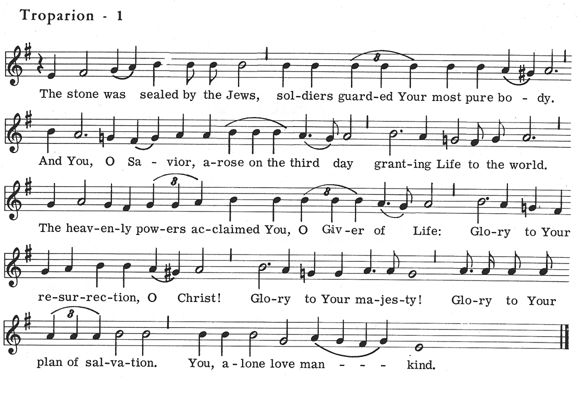
This music is complicated, and more than a bit confusing; every phrase adapts the corresponding part of the melody in the 1906 Prostopinije a little differently. As a result, the cantor and people needed to memorize the whole thing – and then do the same for every other troparion in tone 1.
There were several attempts in the 1980’s and 1990’s to restore the original pattern melodies for the troparia, and finally in 1999 the newly established Inter-Eparchial Commission for Sacred Liturgy and Music reviewed both the original Slavonic sources and the various attempts in English, and created new settings of the troparia and kontakia in the Eight Tones. Here is the troparion of the Resurrection (Sunday troparion) in Tone 1:
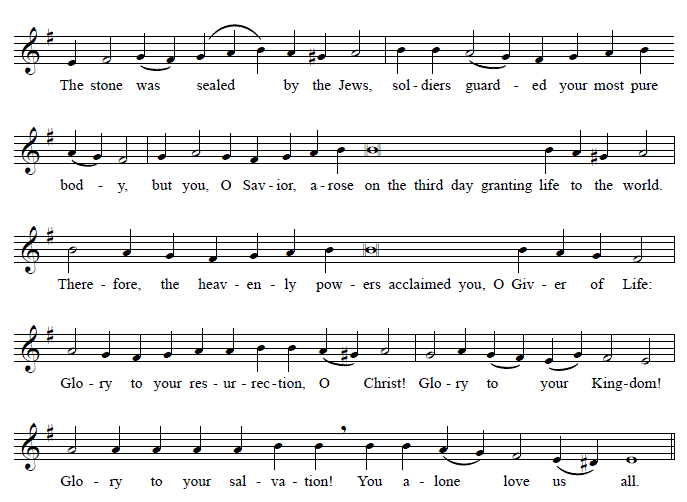
In this setting, it becomes much clearer that the melody consists of two phrases that are repeated in a cycle, following by two ending phrases. So let’s label the repeating phrases A and B, and the ending phrases E and F:

To sing any text to this melody, you would divide the text up into phrases of “reasonable” length, according to meaning, and sing the phrases to the A and B melodies, in alternation, saving the E and F melodies for the last two phrases. This is precisely what we are going to do.
When we’re done, I think you will find that even troparia with written-out music will be a lot easier to sing. And along the way, we can gradually acquire a good sense of how to sing a NEW troparion, or one without written music, to this or any other prostopinije melody.
So let’s imagine that you’ve just opened your copy of the Great Anthology, and you see the following:
Troparion, Tone 1. The stone was sealed by the Jews, * soldiers guarded your most pure body, * but you, O Savior, arose on the third day granting life to the world. * Therefore, the heavenly powers acclaimed you, O Giver of Life. * Glory to your Resurrection, O Christ! * Glory to your Kingdom! * Glory to your salvation! You alone love us all.
Everyone else has this in front of them as well. You are the cantor, and the people are waiting. What do you do?
The A phrase, first time through
Let’s start with some basics. Every prostopinije phrase has to be adaptable to texts of any length, right? So each phrase melody has a reciting tone, a point in the melody where as many words as necessary can be sung in a single pitch. The part of the melody that comes before the reciting tone is called the intonation, while the ending part after the reciting tone is called the cadence.
Unfortunately, the first phrase of the Sunday troparion in Tone 1 (“The stone was sealed by the Jews”) is SO short that it is hard to tell where the reciting tone is. So let’s look at the beginning of the Sunday kontakion in Tone 1 instead. (In Tone 1, troparia and kontakia are sung to the same melody.)

This is better! The first notes, over “As God you a[rose],” make up the intonation; this is the “signature” of the melody, the part which tells the congregation how the music is going to go. While singing it, the cantor also sets the pitch, the tempo, and which language will be used if there are several. The intonation here consists of a short note, a long note, and four short notes, and leads into the reciting tone.
The round note with vertical lines on either side is called a “slashed note” or a “double whole note”; when writing chant, we use it by convention to show that all the words under it are sung on the same pitch, using the rhythm of normal speech. This is the reciting tone. So the cadence consists of the last three notes, the third of which is longer.
We can take out the words entirely, and show the A phrase this way:

Here, the musical accents fall on the second note, the beginning of the reciting tone, and MAYBE the first note of the cadence. The art of setting text to a melody is arranging to have the accented syllables in the text fall in the right places. Here, accents in the text should fall on the half note, the beginning of the reciting tone, and (if possible) on the first note of the cadence.
We start by just singing syllables to notes, then adjust by combining several notes with a slur, or dividing a half note into quarter notes, In this case, the only adjustment we need is to slur two pairs of notes together, and everything works:
Look at the four notes over “you a-“. There are a lot of patterns just like this in prostopinije, and usually they bear small accents on the first and third notes. But sometimes it proves very difficult to do it this way, and we end up with accent on the second note of the four, the low note:

In an ideal world we would use just one of these patterns, but it turns out that neither one really covers all the cases. So cantors need to be aware of the two options, and sing accordingly: four notes with accents on 1 and 3, versus an accent on the low note.
Two other situations deserve mention. If the very first syllable of the text is accented, we can switch the half note to the beginning, as here in the troparion of the Cross:

In this case, the four-note pattern will definitely be accented at the beginning. And finally, if the text phrase has only few accents, we can use the short form that the 1906 Prostopinije provided for “The Lord is God at Matins.” Here is it in English:
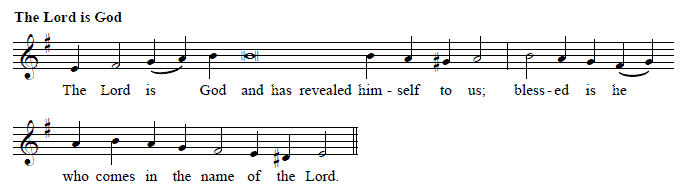
Instead of going down and then up again after the half note, it goes straight up to the reciting tone. But every one of these potential opening phrases is unique to Tone 1 troparion, so it is still clear which melody the cantor is starting.
The B Phrase
Regardless of how it begins, the A phase always ends on re, an “unstable” pitch that signals musically that we still have more to say and sing. To start the B phase, we move one note up the scale, to mi:

Like the first phrase of the Sunday troparion, this text is so short that is has no repeated note or reciting tone. Here is the full form of the B phrase, showing the reciting tone:

We have the same sort of four-note pattern, with several possibilities as to where the accent goes.


Sometimes an initial note is repeated, or a quarter note and half note are swapped to make accents fall correctly. This happens in other prostopinije melodies, but is most common in Tone 1 troparion.
Here again is the complete format for phrase B:
The B phrase ends on another unstable note, ti. We will go on!
The A Phrase, repeated
If there are more than two phrases left, we need go back to the A phrase of the melody. But instead of exactly repeating the opening, we raise the first two notes a bit:

The B phrase can have the same sort of variations as we saw earlier: the first note can be omitted it we begin with an accent, or doubled if necessary:

So here is the complete format for the A phrase when it is repeated.

The E Phrase
Most prostopinije melodies end with a single concluding phrase; this is one of the exceptions. At the end of EITHER the A phrase or B phrase, we can sing the penultimate (E) phrase like this:

Here is the complete format. There are no strict rules for accents; sing as you would speak. If there is a reciting tone, it will usually come on the fifth note.

The E phrase goes down to la below do and ends on it – the lowest note since the beginning of the chant. This helps affirm that we are coming to the end.
The F Phrase
The final or F phrase leaps up to re, and has not one but two reciting tones:

Here is the complete format:

The whole Tone 1 Troparion melody
Let’s try to summarize what we have so far:
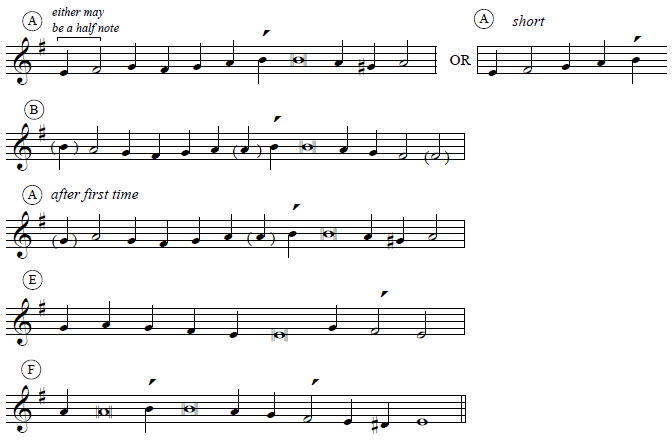
Notes in parentheses are optional.
Back to the Sunday troparion in Tone 1
Here is the Sunday troparion in Tone 1 from the 2006 Divine Liturgies book:
The first two phrases each have an issue which make them difficult:
- In the first phrase, “sealed” is sung over the last two notes of the four-note pattern we looked at, PLUS the first (and only) note of the reciting tone. Thus, it tries to take in both the accent in the middle of the four-note pattern, and the accent on the reciting tone, as a sort of two-fer. (I call this a “bridged accent”, and we’ll look at those in a future installment of Chant Works.)
- In the second phrase, slurring from the half-note to the quarter note on the first syllable of “guarded” adds some instability, and is just hard for many cantors to sing reliably.
If we were doing it all over again. I would use the short form for the initial A melody here, and begin the B phrase with a half note:

By the way, that half-slurred-to-quarter IS sometimes useful – for example, in the Tone 1 troparion for Lazarus Saturday:
Here, the three-note rising pattern on “raised” is an excellent example of “word painting.” One could, of course, sing “raised” on the four quarter notes that immediately follow the half note. More importantly, perhaps, “from the” should probably be sung on the last two quarter notes, so that “Lazarus” stands by itself on the reciting tone. (One flaw in some of the earliest MCI settings was the sense that if notes were slurred in the 1906 Prostopinije, they should always be slurred. This let to some very odd results, which we will encounter later in Tone 3 samohlasen.)
The troparia for January 1
Quite a few cantors have problems with the Tone 1 troparia for the Circumcision of the Lord and the feast of Saint Basil the Great. Here is the troparion of the Circumcision.

The opening phrase, like the Sunday troparion in Tone 1, feels awkward and would sing much more easily to the short form of the A phrase:

In the second phrase, “divine Spirit” has an accent on “-vine” at the very end of the reciting tone, followed immediately by the accent on “Spirit.” This quick succession of accented syllables is hard to sing clearly; it might be better to put a half note on “-vine.” In general, when translating texts to sing to prostopinije, it’s good to avoid strings of accented syllables if possible.
The half-slurred-to-quarter pattern is used three times, and in each case it would probably sing better if the next syllable started on the quarter note that follows the half note, and those two quarter notes were slurred together instead.
Finally, “therefore as man” is just tricky to pace, and breaking it across two lines on the page makes it even harder. Changing the initial half note to a quarter and slurring “man” over two notes would be in improvement. The last two lines, on the other hand, are quite singable as is.
Very like it is the troparion for Saint Basil:

This has the exact same issues: an opening that could benefit from the short A form; a double accent on “divine dogmas”; two avoidable uses of the half-quarter slur; and the tricky “O royal priest” which should probably begin with a quarter note instead of a half. Try different ways of singing it and see what you think!
The troparion of the cross
The troparion of the Cross is so short that the B phrase and E phrases are combined:
The troparion of several women-martyrs
This troparion from the common of saints in the back of the 2006 Divine Liturgies book displays a different kind of problem with setting a chant.

The beginning IS awkward and would benefit from the short form of the A melody. But the more serious problem is in the second line. The hymn seems to come to a stopping place – think of it as a period – after “By martyrdom you were led to Christ.” The next phrase is really a continuation of the same thought, but it sounds like the start of a whole new sentence, and it’s easy to miss the fact that the lambs referred to are the martyrs (and the whole Church!).
In this case, it would be better to merge the text phrases so the rhetoric is more clear.:
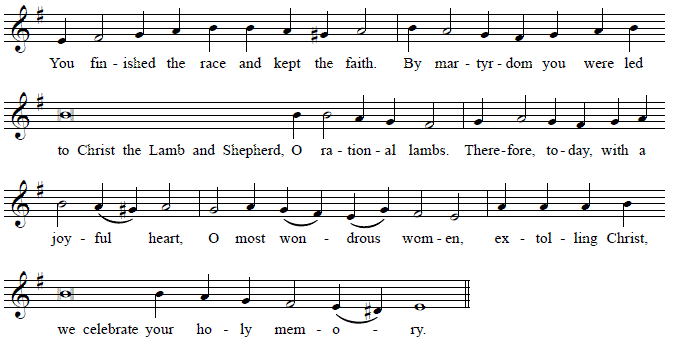
One might also change the half note at the beginning of the E phrase to a quarter, to keep the duple (2 + 2 + 2) rhythm. In general, prostopinije follows a duple rhythm, sometimes at several levels, and avoids dance-like strings of triples – especially triplets. We will come back to this in a later installment of Chant Works.
The festal theotokion in Tone 1
Last one, I promise! Here is the theotokion (hymn to the Mother of God) sung at Vespers and Matins for Sunday after the troparion of the Resurrection in Tone 1. This chant has NOT yet been officially promulgated, and in the coming revision of the Vespers book I would like to fix it up a little. Here is the current version:
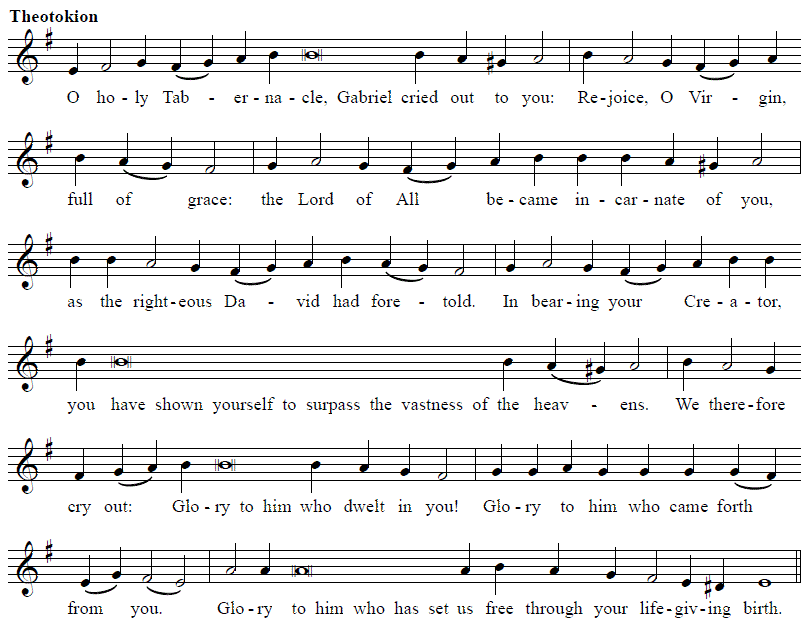
Before reading further, try singing it through and see what you could do to improve it!
For me, at least:
- The opening should use the short form
- At the start of the second line, “full of grace”, I would change “full” to a half note, to put two beats on the reciting tone, and an accent (albeit a weak or secondary one) on the quarter notes that begin the cadence.
- In the third line, “as the righteous David has foretold”, two quarter notes precede the half note, and “David” is slurred unnecessarily. Instead, put “as” on the half note, and the remaining syllables exactly match the remaining notes in the phrase.
- In the next to last line, “Glory to him who came from you” ends with two half notes slurred together over “you.” A slur on a final syllable is almost always untraditional in prostopinije (there is ONE exception, in Tone 6 troparion, and most cantors are uncomfortable with it). Here is is unnecessary.
- In the last line, “free” is the only word on the second reciting tone, and would be better as a half note for the same reasons as “full” in “full of grace” above.
What might it look like in the next Vespers book? As they say in Church Slavonic, Voilà!
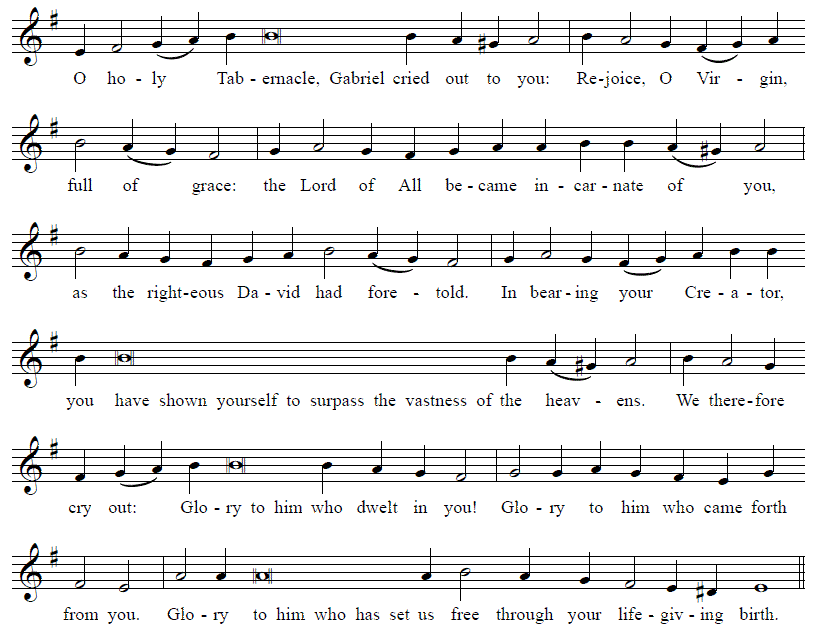
I hope you have found this enlightening. We covered a LOT of ground in this installment. Later this week we’ll consider the much easier prokeimenon melody in Tone 1 (easier to analyze, at least, not necessarily easier to sing), then move on to Tone 2 next week!
If you have ANY questions or comments, please add them to this post!
You can find a complete table of the prostopinije melodies for troparia, with their starting notes, patterns, and examples, here: Melodies for troparia.