Welcome back to the Chant Works series, in which we take a deep dive into the prostopinije (Carpathian plain chant) used in the Byzantine Catholic Church. To inaugurate the series, we are going through the melodies of the Eight Tones for the Divine Liturgy, one at a time. In our last installment we looked at the Tone 1 troparion melody; this time we will explore the Tone 1 prokeimenon melody.
Prokeimena and Alleluia
A prokeimenon (from the Greek meaning something like “what stands before”) is a responsorial chant sung in the Byzantine Rite. Prokeimena usually take their texts from the Psalms:
- A soloist, or (in our church), the cantor and congregation sing a selected verse from the appointed psalm, the in the tone prescribed for the prokeimenon.
- The reader (or deacon) intones another verse from the same psalm, usually the first verse (while the prokeimenon itself is chosen to represent the theme of the celebration).
- The soloist (or cantor and congregation) repeat the prokeimenon.
Most prokeimena have a single chanted verse, but some (so-called Great Prokeimena) have several verses, and the prokeimenon is repeated after each verse.
(In some traditions, the prokeimenon may be intoned without music before it is sung, and the last few words of the prokeimenon may be repeated as a refrain after each verse, with the entire prokeimenon sung at the end. But in our church singing tradition, we tend to keep it simple, as described above.)
Before the Gospel at the Divine Liturgy, another prokeimenon is sung, consisting of the words, “Alleluia! Alleluia! Alleluia!” Here there are several verses, with the triple Alleluia sing after each. The whole thing is simply called “an Alleluia.”
At Vespers, there is an evening prokeimenon, and at Sunday and festal Matins there is a prokeimenon before the Gospel, and two more hymns sung in the prokeimenon style: “Let everything that lives and that breathes” (before the Gospel) and “Holy is the Lord our God” (on Sundays after the canon). In these services, the verses are intoned by the deacon. There are also prokeimena and Alleluia sung as “stand-alone” hymns at other services, such as baptism and the funeral service.
The Tone 1 prokeimenon in the 1906 Prostopinije
The same melody is used for singing all prokeimenon in Tone 1, as well as the Tone 1 Alleluia. In fact, it might be more correct to call these Alleluia melodies, since each prokeimenon melody consists of three musical phrases, which correspond to the triple “Alleluia!”
As we mentioned last time, the prostopinije melodies were not collected into a printed book until 1906, when the Tserkovnoje Prostopinije or “Church Plain Chant” of Ioann Bokšai and Iosif Malinič was published in Užhorod, in the far west of modern Ukraine.
In the 1906 Prostopinije, the Tone 1 prokeimenen melody appears five times, with texts for the prokeimenon at Matins, “Let everything that lives and that breathes,” “Holy is the Lord our God”, and the Sunday prokeimenon and Alleluia at the Divine Liturgy. The basic melody is the same for all four, with only small stylistic variations to fit the different words.
Here are the Alleluia and prokeimenon for the Sunday Divine Liturgy, in Tone 1:
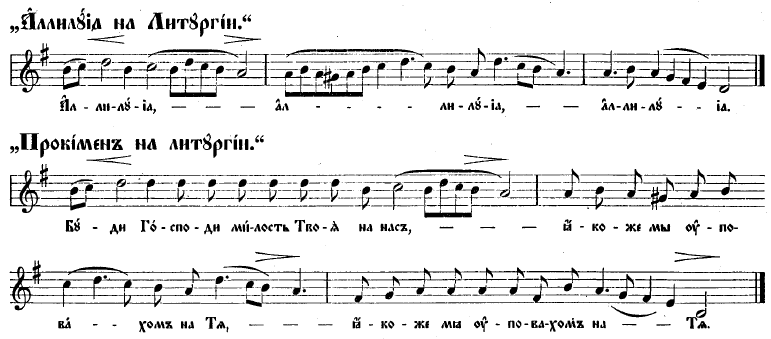
Even if you don’t read music fluently, you can see that these two melodies are essentially the same. All other prokeimena in Tone 1 are sung to the same melody, with minor variations to fix the text. These sorts of changes were made instinctively by the cantor, and followed by the people.
Listen to the 1906 version of the Alleluia and prokeimenon in Tone 1:
The Tone 1 prokeimenon melody in English
In our church here in the United States, the use of English for liturgical services began in the 1950’s. As cantors and congregations adapted the prostopinije chants to English, they ran into two sources of difficulty:
- When a Church Slavonic text is translated into English, the translation is usually much shorter (that is, has fewer syllables).
- The prokeimena melodies in prostopinije are very florid, with lots of notes and melismas (runs of notes over a single syllable). The Alleluia needed to be long in order to “cover” the incensing of the church and people that took place before the reading of the Gospel.
In the United States, following the example of the Latin Rite, brevity was preferred, and in fact, the incensing before the Gospel was often done during the reading of the epistle (which was in Slavonic anyway) . It became customary for the Alleluia verses to be omitted, and both the prokeimenon and Alleluia to be abbreviated.
Here are the first official settings for our church in English of the Sunday prokeimenon and Alleluia in Tone 1, from the 1970 collection Byzantine Liturgical Chant:
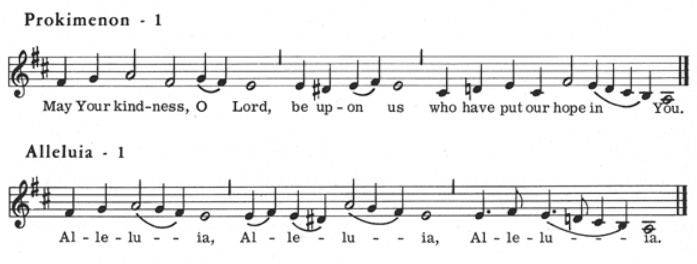
The procedure used in creating these seems to have been to match up English syllables to notes, and then leave out any of the notes in the original melody that weren’t used. Unfortunately, this means the prokeimenon and Alleluia were shorted in different ways, and it became quite hard even to see that they were the same melody. In the end, most cantors and congregations just memorized them separately.
Around 2002, the Inter-Eparchial Commission for Sacred Liturgy and Music prepared new settings of the prokeimena and Alleluia in all Eight Tones which EXACTLY matched the Slavonic, and these were distributed on a cassette tape (along with the troparia and kontakia) to Metropolitan Cantor Institute students in 2002 or 2003. But later a decision was made to slightly simplify the prokeimenon and Alleluia melodies in Tone 1 by removing a repeated run of notes, and leaving out a particular pedal-tone in the prokeimenon:
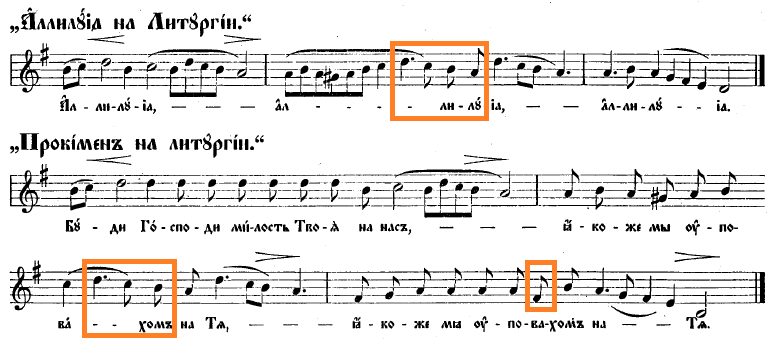
Here are the resulting Sunday prokeimenon from the Tone 1 section of our 2006 Divine Liturgies book.
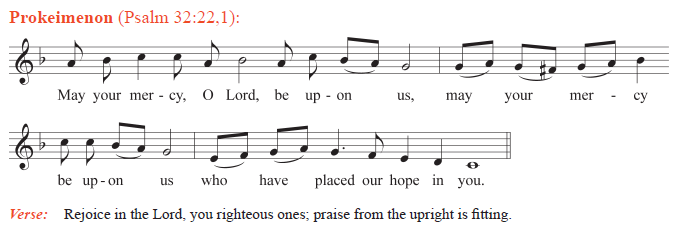
Notice that the words “May your mercy be upon us” are repeated. Since psalm verses often divide into two half-verses, while the prokeimenon melody has three musical phrases, this sort of repetition is very common.
Here is the Alleluia in Tone 1:
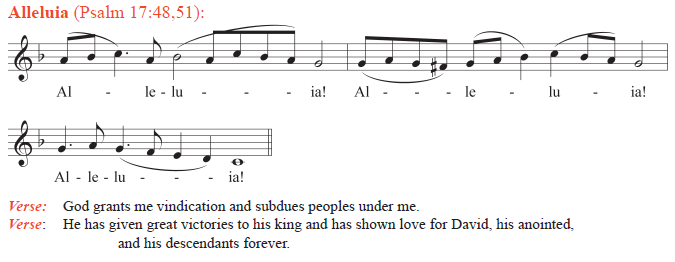
The Divine Liturgies book also provides music for the prokeimena for Sundays and feasts through year, the daily prokeimena for Vespers, and the common prokeimena for classes of saints and for special intentions.
Chanting the verses for the prokeimenon and Alleluia
In our church, it is customary for the reader (or the deacon, and Vespers or Matins) to chant the psalm verses of the prokeimena and Alleluia very simply, usually to a psalm tone:

It is extremely helpful if the psalm verses can be chanted in the same key (that is, with the same tonic pitch or do as the prokeimenon or Alleluia itself); this helps maintain a thread of musical continuity and “flow” though the service, and avoids clashes and discord.
Since the prokeimenon and Alleluia in each tone begin and end on particular notes, readers (or, if there is no reader, the cantor) can learn by listening and experience to find the proper starting pitch for the psalm verse. To make this easier, the Metropolitan Cantor Institute has provided a “cheat sheet” for each tone, showing the prokeimenon and Allleuia melodies, AND the pitches for the psalm tone for the verse(s).
Here is the “cheat sheet” for the Tone 1 prokeimenon melody:

This shows the solfege syllables for the beginning and end of the prokeimenon, with the psalm tone for the verse to the lower right.
In the case of Tone 1, the reader goes UP a perfect fourth from the end of the prokeimenon to the start of the psalm verse, which begins and ends on the same note. Then the cantor goes UP a major third (to mi) to repeat the prokeimenon.
Here is the corresponding cheat sheet for the Alleluia:

The entire cheat sheet for all eight tones can be found here.
Combining prokeimena
When several liturgical events fall together – for example, when a feast day falls on Sunday – the Typikon or book of liturgical rules tells how the combine the different prokeimena and Alleluia.
When two prokeimena are sung together:
- The first prokeimenon is sung by cantor and congregation.
- The reader chants the verse.
- Then IMMEDIATELY the second prokeimenon is sung – even if it is in a different tone! Ideally, the cantor finds the proper pitch for the second prokeimenon from the end of the chanted psalm verse, and in most case the congregation will follow without a hitch.
- (The verse of the second prokeimenon is omitted, and the second prokeimenon is not repeated.)
The procedure is similar for when combining Alleluias, which usually have several chanted verses. In this case, the first Alleluia, with its verses, is sung and chanted, then in place of the final repetition of the first Alleluia, the cantor starts the second Alleluia, and the reader chants the verses from that Alleluia, with one final singing of the second Alleluia.
NOTE: Most Alleluias have two verses, and in practice, many parishes will only take the first verse of the second Alleluia.
Yes, it’s a bit confusing! If you have questions, please add them as a comment on this post.
Looking at our prokeimena in Tone 1
If you go to the reference chart for prokeimena on the Metropolitan Cantor Institute website and click on Examples to the right, you can find ALL the prokeimena in the 2006 Divine Liturgies book, sorted by tone (with links to recordings!). This is an excellent way to learn the prokeimena. And as we go through then, we can see a few places in which they might have been done differently.
For example, here is the Tone 1 prokeimenon for a holy hierarch (bishop):
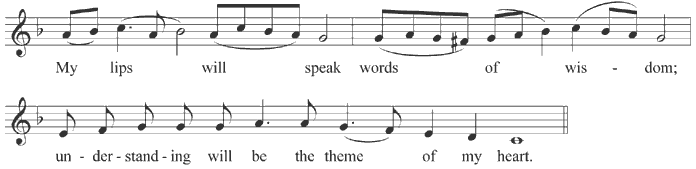
If you look at the phrase “understanding will be the theme of my heart,” the high note over “be” is accented and held for the length of a dotted quarter note; but in the Sunday prokeimena and Alleluia in Tone 1 this high note is a quick (eighth) note which is followed by an accent. Here is how it might be sung a bit closer to the traditional melody in Slavonic:

The same thing happens in the Vespers prokeimenon for Tuesday evening, where the high note is held even longer:
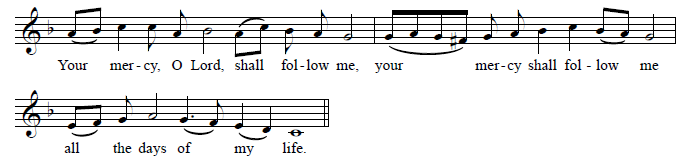
For myself, I would rather sing it like this, and it is possible that it may appear this way when our Vespers books are revised:
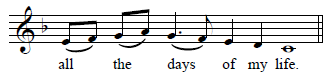
This is also a good example of how text can be gently repeated to fit the three-part prokeimenon melody in the prostopinije style.
A follow-up from last time!
In the previous blog post on the Tone 1 troparion melody, I mentioned that Tone 1 kontakia use the same melody as the Tone 1 troparia. (This is not necessarily true of other tones, as we will see in a future installment of Chant Works.)
At least one of these kontakia deserves our attention. Here is the kontakion for Meatfare Sunday, a week before the start of the Great Fast. This is one kontakion cantors have pointed to, saying it was just hard to get right.
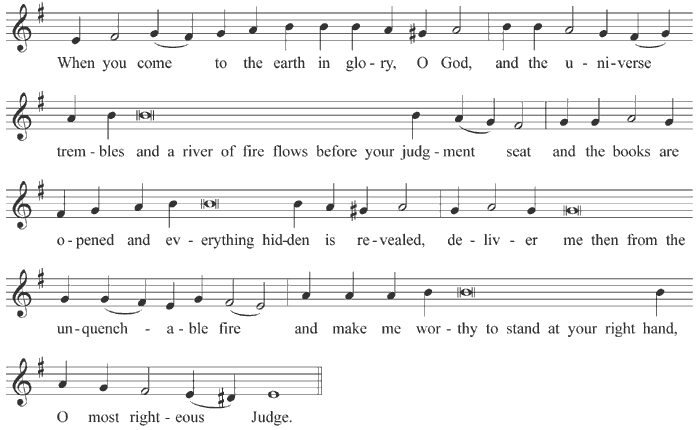
In the first phrase, the two-note cadence should probably be sung over “O” rather than the end of “glory.” In the second phrase, two quarter notes precede the accent, requiring a slur later; the whole phrase really could be sung more simply, without repeated notes or slurs. But most significantly, the second phrase sends with the unaccented -ment of “judgment” sung over the first two notes of the cadence, the first of which is normally accented.
Consider the following. Does it seem like an improvement?
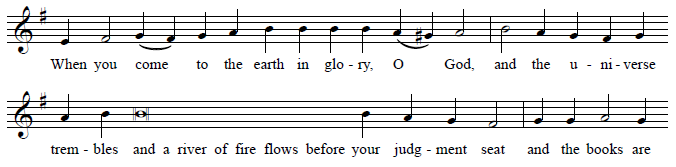
Now, we aren’t changing the printed music any time soon. But it’s always worthwhile to see how we MIGHT sing a chant; it helps us figure out why we are having problems when we do, and makes it possible to prepare better, more traditional chant settings for new services and books in the future.
This Saturday night, we switch tones for the new week. On to Tone 2!