Welcome back to the Chant Works series, in which we take a deep dive into the prostopinije (Carpathian plain chant) used in the Byzantine Catholic Church. Next week, the third after Pentecost, we will be in Tone 2, so let’s see what we can discover about the Tone 2 troparion melody.
The Noble Joseph
Perhaps the best known troparion in Tone 2 is the one sung at Vespers in our churches on Great and Holy Friday. Toward the end of this service, the priest takes an elaborately decorated cloth called the plashchanitza, bearing the image of the dead Savior, and carries it on his back through or around the church in a symbolic burial procession, to a place which has been prepared for the plashchanitza to remain until the beginning of Pascha.
During this procession, the following troparion is sung slowly and repeatedly, sometimes in several languages:
The noble Joseph * took down from the Cross your most pure body. * Anointing it with spices, * he wrapped it in pure linen, * and placed it in a new tomb.
The melody used for this hymn differs in several ways from the Tone 1 troparion melody we looked at previously. It consists of a single phrase, repeated over and over, and while this phrase has a reciting tone (bearing a variable amount of text on a single pitch), the rhythm is not that of ordinary speech, with faster and slower syllables, but comes at a steady, processional pace – you can almost imagine the feet of those in procession hitting the ground with each beat.
Here is a recording of “The Noble Joseph”, as sung at Saint Mary’s Byzantine Catholic Church in Nesquehoning, Pennsylvania in 1993, under the leadership of Cantor John Katchen. (This recording was provided to the MCI by his daughter, Johanna Katchen.)
Listen to at least a little before continuing; the troparion is sung in both Church Slavonic and English.
The Tone 2 Troparion melody in the 1906 Prostopinije
In the Tserkovnoje Prostopinije or “Church Plain Chant” of Bokšai and Malinič, here is the troparion of the Resurrection (the Sunday troparion) in Tone 2:
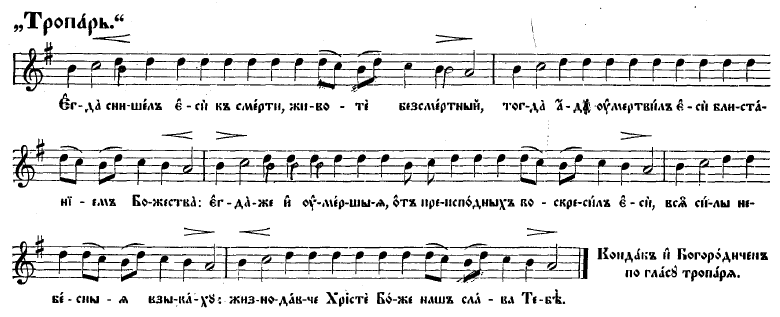
There are several points of interest here. First, the same musical phrase is repeated five times; it has the following format each time:

The initial note on mi is followed by a note twice as long on fa, then the reciting tone on so, ending with a quicker four note pattern, then two quarter notes, and a half note on the final, unstable re. The accents mark places where a stress in the text can occur naturally.
But take a look at the middle of the second line of music; where a comma occurs in the Cyrillic text, the initial mi-fa notes are repeated to keep things from being TOO monotonous, and to make up for the lack of any pause in the rhythm of the text.
Second, the owner of this copy of the Prostopinije made penciled-in changes at several points. These presumably reflect either the oral tradition the owner was used to, or a slight “prettying-up” of the melody.
Finally, the inscription after the end of the chant explain that kontakia and theotokia (hymns to the Mother of God) in Tone 2 should be sung to the same melody.
The Tone 2 troparion in English
Here, for comparison, is the first official setting of the Tone 1 Sunday troparion in English; this is from Byzantine Liturgical Chant (1970).
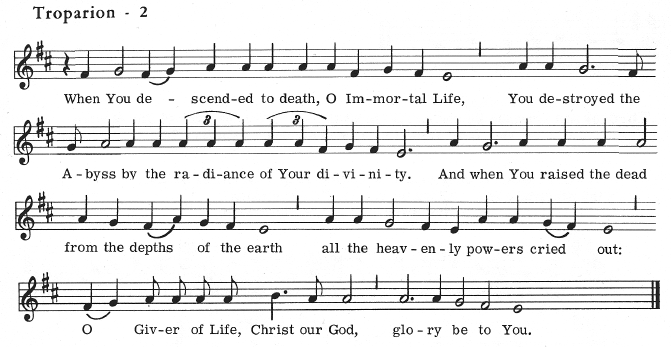
Here, every phrase of the troparion uses a different rendering of the melody. An accent always falls on the half note, which may be two or three beats long, or entirely absent (in the last line). The note before the half note may be higher or lower, and may be repeated (“You desTROYED”, “all the HEAVenly”). And the cadence that comes after the reciting tone is also different every single time.
As we saw with the Tone 1 troparion and prokeimenon melodies, this means, first, that anyone wanting to learn to sing this troparion must memorize the whole thing; and second, when singing other troparia, one either has to have a written version, or drop back to using the Slavonic form, or simply “wing it.” Sadly, the last option often ended up being the case.
Here is how the Inter-Eparchial Music Commission restored the melody in the 2006 Divine Liturgies book:

As both a descendant of the chant in Slavonic and an example for setting other troparia, this is certainly much better. The same musical phrase is used each time, and the mi-fa-so opening is always present, usually on quarter note, half note, and the reciting tone, though sometimes the first note is doubled. The eighth notes in the cadence are restored.
At the end of the second line, “raised the dead from the depths of the earth” is a little… busy. Normally, the eighth notes are sung in pairs, but here all four sing different syllables, AND a quarter note in the cadence is split up to sing “of the.” Unfortunately, the alternative to these machinations is to sing “raised the dead from the” on the reciting tone, and “depths” on all four eighth notes. We will come back to this point later.
You can find all the Tone 2 troparia and Tone 2 kontakia in the Divine Liturgies book here and here. In general, they are all set in pretty much the same style. So we’re all done, right, and we can move on the Tone 2 prokeimenon and Alleluia?
Not. So. Fast.
Issue #1: The intonation, or opening notes
The new settings in English restored the final cadence and the opening pitches. But the opening rhythms are all over the map:


I suspect that the goal here was the laudable one of avoiding “bad accents.” But here again, if less obviously, is a case where every troparion needs to be written out, and sung according to the printed page, by both cantor and congregation. Here, the editor has done all the work, and the cantor just needs to sing what is written, correctly observing long and short notes. Too often, the words over the reciting tone are simply “executed” in order to get to the next part, and expressiveness suffers. Getting the opening rhythm “right” isn’t that helpful if the rest of the phrase is done mechanically.
But there is an alternative, and in some ways a simpler (and more traditional) one. Musical accents are not only made by pitch and duration; they can also be shown by amplitude (loudness), attack (how quickly one launches into a note), and very small changes in pitch (for example, a slight and almost unnoticeable “scoop” in pitch at the start of a word).
The idea of singing any other pitch than what is written is controversial, because we teach singers never to audibly “scoop”: start lower than the written pitch and sliiide up to where it’s supposed to be. But SMALL versions of this occur anytime we speak, to give the words expression. (That is why someone speaking without any sort of expressiveness is said to speak in a monotone.)
So I am going to go out on a limb here and assert that almost any text can be sung to the opening quarter / half / quarter pattern of the Tone 2 troparion in Slavonic without messing up the accents. I’m going to deal with the other issue first, then show you an example of what I mean.
Issue #2: The Reciting Tone
Almost all our music (both the official books, and additional material from the MCI) is typeset using a program called Finale. And when doing projects this big, it is very tempting to “cut and paste.” So it is not surprising that the reciting tones in Tone 2 troparia have the same slashed-note-with-words-under-it for the reciting tone that the other tones have.
The problem is that the prostopinije troparion melodies in tone 2 and tone 8 (and to some extent tone 5 also) are fundamentally different. All the text on the reciting pitch is sung in a regular, processional rhythm – each syllable approximately the same length as the next, as if to a slow march, quick step, or something in between, depending on the liturgical context.
We have endless problems teaching this to new cantors, who see the slashed note and just dash off the words in the rhythm of normal speech. In hindsight, it would have been much better to write out the reciting tones for Tone 2 and Tone 8 troparia in quarter notes or half notes, respectively.
The Tone 2 Sunday kontakion
Putting these two ideas together, let’s imagine how the kontakion of the Resurrection in Tone 2 might be written out and sung in English, a bit closer to the original Slavonic melody.
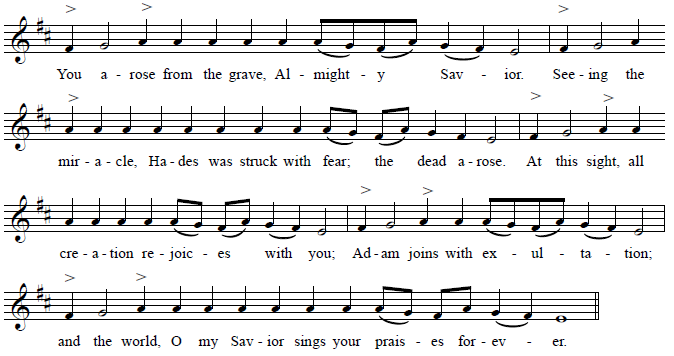
From the very beginning, we sing differently. Focus on that first word, “you”: we are addressing the risen Christ! This deserves a slight emphasis, louder then immediately backing off. We start to sing the next word, holding it out in expectation, then explode triumphantly into the rest of the word: aROSE. Keep the volume up, emphasizing “alMIGHTy” with that almost imperceptible scoop I mentioned, and then “Savior” on slower notes after the eighth notes of “-mighty.”
We do the same with the next line: Seeing, emphasized. Miracle, emphasized. Also Hades and struck, faster on the fear of Hades, slower and more solemn as the dead arise. Keep going, emphasizing every important word. By the time we reach the last line, our vision is vast: And the WORLD, O my Savior…
It’s true that much of this is all on one note, repeating the same musical phrase over and over, but it can be the farthest thing in the world from boring! Tone 2 and Tone 8 troparia, in this processional rhythm, can actually be sung in a way that is completely captivating to singers and hearers alike.
(By the way, that trick of an accented short note, followed by an UNaccented longer note, is not restricted to chant; it also occurs in British Isles music as the “Scotch snap.”)
Note that I am NOT saying we should change the music we have. But I want to point to how we could sing BETTER, more meaningfully, than we sometimes do, and still keep our traditional melodies as they have come down to us.
The Noble Joseph, revisited
Here is the processional troparion for Great and Holy Friday in the same style:
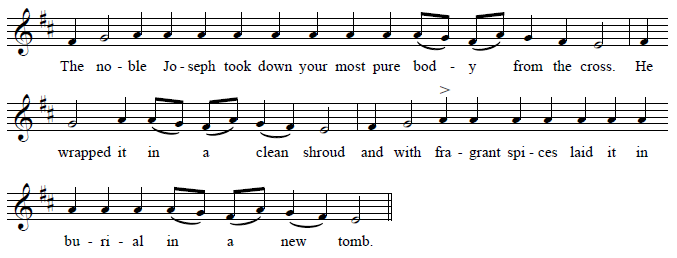
You would apply the same stylistic techniques described above. Though it is sung slowly, the intensity should palpabe. Imagine you can still hear the echo of nails being driven, and the slow, careful preparation of the body of the Christ for burial. Even though you may sing this chant twenty or thirty times during the procession, if the cantor leads it with vigor and the people sing from their hearts, this troparion can be awe-inspring. And it does not need variations in the melody, triplets, elisions, etc., etc. – just the traditional tune.
There are two minor variations that ARE worth pointing out. In general, as Sister Joan Roccasalvo pointed out many years ago, we avoid triple (waltz) rhythms in prostopinije. Most chants are duple (in two), or a mix of two- and three-note patterns; we try not to sing 1-2-3 1-2-3 for very long. So we might sing “LAID it in BUrial” as follows, changing the rhythm to 1-2-3 1-2:
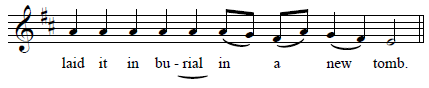
Or we could raise the first note of “burial” by a step; many parishes do this.

But I wouldn’t do both – that is, sing “burial” as two syllables, with the first one raised – as it would make the word harder to understand when heard. And the text of our hymns is always of principal importance.
Next up…
That’s enough for one installment, I think. Tomorrow we’ll take a look at how we might harmonize this melody, before going on to consider the Tone 2 prokeimenon melody.