Five weeks into the cycle of Eight Tones! In this installment of Chant Words, we will look at the melody used for singing troparia and kontakia in Tone 5 in the prostopinije tradition and, just perhaps, engage in a little creative simplification.
The Tone 5 Troparion melody in the 1906 Prostopinije
Sometimes we can fool ourselves due to sheer familiarity. The 1906 collection Tserkovnoje Prostopinije (“Church Plain Chant”) begins with the basic melodies in the eight tones, with examples of each. Here is the troparion of the Resurrection (the Sunday troparion) in Tone 5:
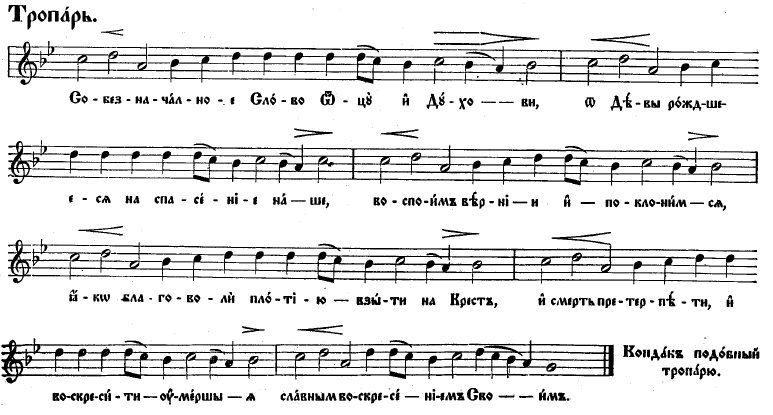
The little note at the end indicates that this melody is also used for kontakia in Tone 5.
Clearly, this melody consists of a single repeating phrase. Here is how I have been teaching this melody at the MCI for many years:

except for the very last phrase, which expands the cadence:

See the accent over the second note? That’s the “fooling ourselves” part.
Let’s look at the English settings of this melody, and then I’ll explain why I think the two lines of musical explanation above are not quite right.
The Tone 5 troparion melody in English
Here is the first official setting of the Tone 5 Sunday troparion in English. from the collection Byzantine Liturgical Chant (1970):
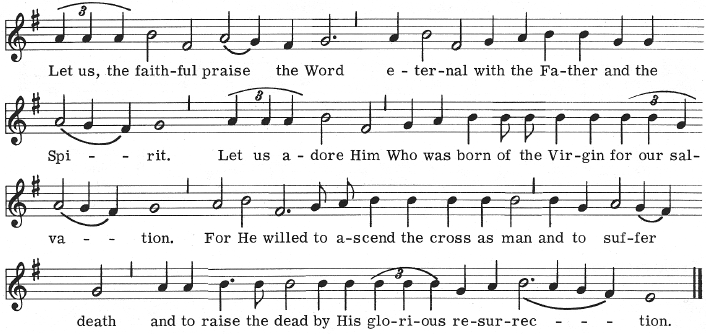
Because this is the only Tone 5 troparion regularly employed at the Divine Liturgy, we sang it this way a LOT back in the day. Compared to the Slavonic music above:
- The beginning three half notes (re mi ti) are treated a little differently each time: the first half note is shortened or subdivided so that the first internal accent (the fia) falls on the middle half note. In the last phrase, the third half note (on ti) disappears entirely.
- The falling eighth notes before the cadence are merged into a quarter note on the same pitch.
- Every phrase is treated a little differently, in both pitch and rhythm.
Now let’s look at the version in the 2006 Divine Liturgies book:

This is much closer to the Slavonic and is a little awkward in places, but no more so that the 1970 English setting. It is more predictable (and hence a better example for setting other Tone 5 texts, mostly kontakia) and the rhythm is easier to catch.
But there is one aspect of the Slavonic that neither of the English versions catches at all. The Slavonic Tone 5 phrase opens with three half notes, period, regardless of where the accent falls, while the English settings always put the accent in a middle, and fudge the syllables before and after to fit.
So where does this particular habit come from? Many prostopinije arrangements from the 1970’s and 1980’s treat any high note as an accent. But this is simply not the case in prostopinije, and it’s not really the case in English singing in general (or Slavonic or German or other languages). Consider the beginning of Silent Night:

Try to sing this in such a way that the highest note (the A) is accented. You might do this singing si-IGH-lent night, ho-OH-ly night, or just by omitting the first note on each measure and lengthening the next. But either way, you have significantly changed the tune.
So after a lot of wrestling this Tone 5 troparia and kontakia for the Menaion, I would suggest we at least consider conceptualizing the Tone 5 troparion phrase like this instead:
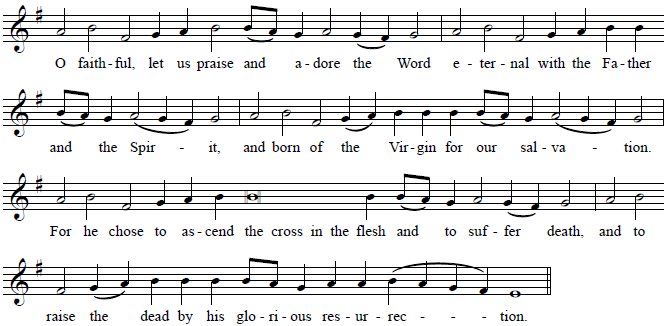
Like the idea of usually singing the second note of a Tone 2 troparion phrase as a half note, singing the initial three half notes each time in Tone 5 simply makes the music more predictable, and more memorable. Am I proposing an immediate change? No! But I will certainly consider setting new Tone 5 troparia and kontakia in this style – and knowing THIS way to sing it brings the current published music into clearer relief, so you can sing it better as it is.
When accents collide
Alert readings may have noticed that I made one other change in the Sunday troparion above: in the first measure, the note over “praise” is a half note.
I first tried it this way because this is a frequent problem for new cantors in our classes (and sometimes experienced ones as well!). The reason is easier to see if you imaging a slow count while singing the phrase as currently written:
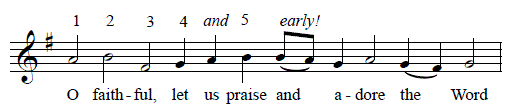
There is just ONE syllable, “praise” on the reciting tone, and it will be accented. But it is immediately followed by the preparation for the cadence, the eighth notes on “and”, and this is ALSO accented. This throws off the duple rhythm, and many cantors either pause here, or slow down.
Remember the rule from a few weeks back: if a particular note is accented, then the syllable on the previous note should NOT be accented. Here we have just seen why! Instead, look what happens if we count out with a half note instead:

Now we can get all the way to the end of the phrase while keeping the even rhythm. All of these considerations explain why, from now on, I plan to teach the Tone 5 troparion melody with no accent on the second half note, no preparatory notes (since a word almost always crosses from there to the cadence), and a cadence with two accents:

One more thing…
I’ve had occasion to mention the idea of a “bridged accent”: a syllable sung from one accent to another. This is very similar to what happens when we force an accent in the middle of a syllable, and the two cases can occur together.
Consider how the Glory… is sung before a kontakion in Tone 5:

Here the “Glory” has an accent in the middle of the word. Applying the pattern above, we could do the following instead:

On the other hand, the stress pattern of the “Now and ever and forever…” makes it really hard to sing “Now and ev-” on half notes; the rest doesn’t come out right. So in this case, we are certainly better off splitting the first half note instead:

We do this not to put the accent on the high note, but to make sure the first accent of the cadence falls on forEVer. Amen!