In the prostopinije tradition, just as Tone 3 has its own kontakion melody (based on the melody of the Christmas kontakion), Tone 4 has one based on the kontakion of Theophany.
(Our study here will be based on the concepts and terminology developed in the article on the Tone 4 troparion melody. Please read that article first if you haven’t already!)
The Tone 4 kontakion melody in the 1906 Prostopinije
Last week I explained how the hymns at Matins and the Divine Liturgy called kontakion (and which are just remnants of the older liturgical poem also called kontakion) are usually sung, at least in the Carpathian chant or prostopinije tradition, to troparion melodies – escept in four of the eight tones. In those four cases (Tones 3, 4, 6, and 8) they use troparion-like melodies which were probably based on special melodies for feast-day kontakia.
The first section of the Tserkovnoje Prostopinije of Bokšai and Malinič provides basic examples for all our eight-tones melodies, including the troparion and kontakion of the Resurrection, used on Sundays and in the Paschal season. Here is the kontakion of the Resurrection in Tone 4:
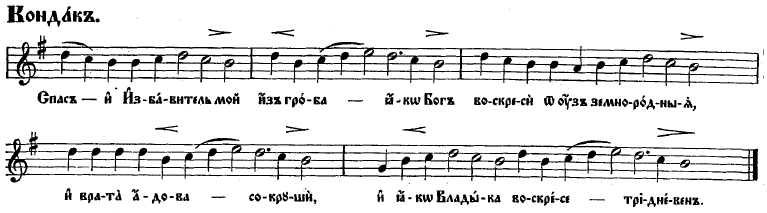
Like the Tone 4 troparion melody, we have two repeating phrases, which we will call A and B. But unlike the Tone 4 troparion melody, here there is no separate melody for the last phrase; instead, we have the A and B phrases sort of welded together, as there is not enough text to make them complete.
First, tt’s also worth pointing out that a few of the ornamental notes are not usually used when singing Tone 4 kontakia, and tend to drop out unless they are needed due to special circumstances. I’ve marked them here, in orange.
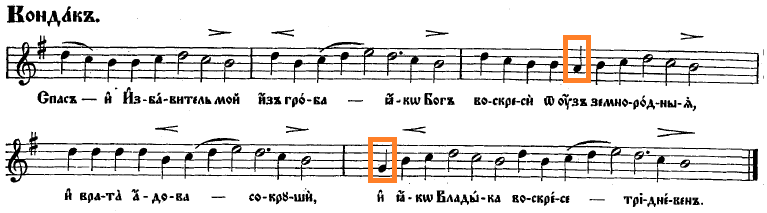
Second, there are three notes in the B phrase that always seem to go together. This means they will tend to form a group, with an accent at the beginning:

Understanding the Tone 4 kontakion melody
Here is the first repeating phrase, or A phrase:

Where the Tone 4 troparion melody ascended to the reciting tone, this one descends, with an accent on the start of the reciting tone in almost every circumstance.
A higher note signals the transition from the reciting tone to the cadence, which just as in the troparion melody consists of three half notes; the last internal accent in the phrase text (the lia) goes on the first half note, and the second half note may be split into two quarter notes if necessary. Easy!
Here is the B phrase:

There is no intontation, and the single preparatory note leads into a cadence with two accents.
And that’s it! We repeat the A and B phrases, back and forth, ending with the B phrase, and holding the very last note a little longer to signal the end.
The Tone 4 kontakion melody in English
Here is the melody as it appeared in the first official English setting of the eight tones, in the 1970 collection, Byzantine Liturgical Chant. It is preceded by the Glory… now and ever, which as we mentioned earlier is sung before the kontakion at the Divine Liturgy, using a short form of the same melody.
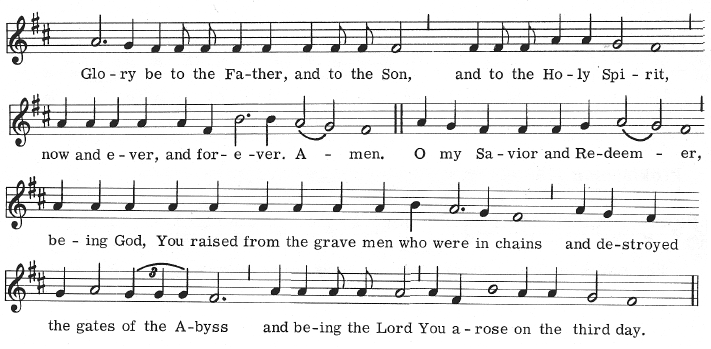
The A phrase is fairly close (although the rhythm in the Glory… is rather jerky), but the B phrase is significantly simplified, with the distinctive three-note pattern at the start of the cadence completely missing.
On the other hand, here is the Sunday kontakion in the 2006 Divine Liturgies book. This is a good example of how the form of the older Slavonic melody was restored in a way that stays singable, and can be learned and internalized.

Here the accents are in the same place as the Slavonic, which respecting the English text, AND one of the ornamental notes is employed as well, on “the” in “destroyed the gates.”
And here is the kontakion of Theophany (January 6):

You can see all the Tone 4 kontakion examples from the Divine Liturgies book here. There are quite a few – 23 in all! – and all of them follow the same basic melody described, with the accented three-note pattern in the B phrase.