Welcome back to Chant Works, where are delve into the nuts and bolts of the Carpathian plain chant (prostopinije) tradition. This week, we will take a look at the melodies in Tone 4, beginning with the troparion melody.
Along the way, we’ll start to look at some “cantorisms” (local variations), especially ones that come from harmonizing the chant.
The Tone 4 Troparion melody in the 1906 Prostopinije
The 1906 collection Tserkovnoje Prostopinije (“Church Plain Chant”) is our basic resource for prostopinije in Church Slavonic; it begins with a section of music in each of the eight tones, in order. Here is the troparion of the Resurrection (the Sunday troparion) in Tone 4:
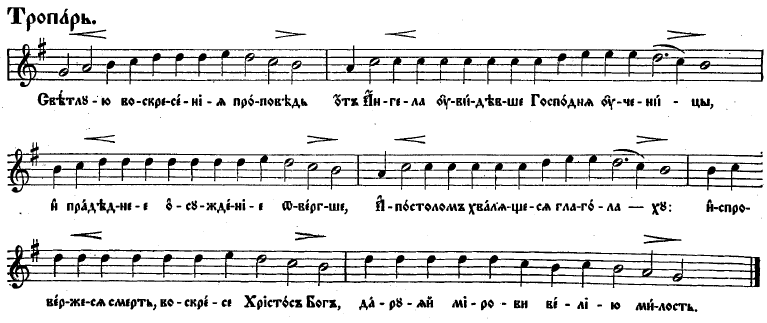
Even if you don’t read musical fluently, you can see that the melody has two repeating phrases: the 1st, 3rd, and 5th phrases are basically the same, the 2nd and 4th are almost exactly the same (except for the number of repeated notes in the middle), and the last or ending phrase is different. Also, the VERY first phrase begins idiosyncratically, with two slow longer notes and three shorter ones; this beginning is particular to the Tone 4 troparion melody, so that everyone listening knows which tune to expect for the rest of the hymn.
In the Byzantine liturgical books, Tone 4 is rather a festive choice, being assigned to quite a few major feasts and celebrations throughout the year. Thus, it was one of the best known to congregations.
The Tone 4 troparion in English
Here is the first official setting of the Tone 4 Sunday troparion in English. from the collection Byzantine Liturgical Chant (1970).
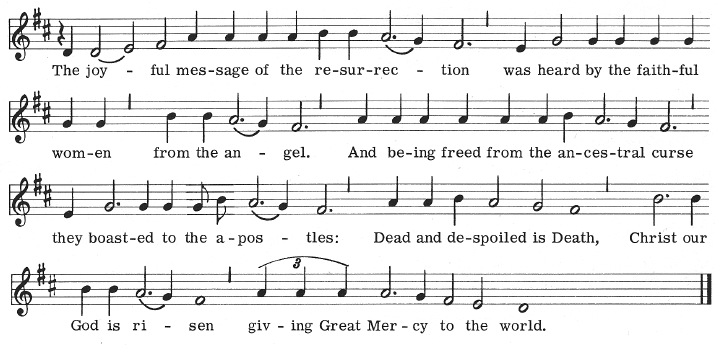
A couple of things to notice:
- In the first phrase, instead of proceeding by scale steps, there is a leap from “-ul” up to the accented word “message.” This also occurs in later Slavonic versions, and probably started as a tenor harmony. (We will talk later about how that happens.)
- In the next to last line, “Christ or God” starts on a higher pitch than the parallels like “boasted to the.” Again, this is probably a tenor harmony,
- The ending is simpler than in the Slavonic, while the rhythms are more complicated throughout.
Here is the version in the 2006 Divine Liturgies book, which in many ways marked a return to the form of the same melody in the Slavonic:

This version is not just closer to the Slavonc in the 1906 Prostopinije; it is more regular, meaning it can be used more easily as a pattern for singing other troparia in the same tone. In the next section, we’ll look at why.
Analyzing the Tone 4 troparion melody
In previous installments of Chant Works, we developed some terminology for talking about plain chant melodies. Now we’re going to put it into effect.
Here is the form of the melody you use when singing the FIRST phrase of a troparion in Tone 4. (Remember that we divide the text of each hymn into sections that “make sense together.”)

The intonation (first few notes, up the reciting tone) kicks off the melody, identifies it to the congregation, and sets the starting pitch and tempo. It is immediately following by the reciting tone, with a variable amount of text chanted on one pitch.
The reciting tone almost always begins on an accented syllable, such as the “mes-” of “message” in the Sunday troparion above. But since there are four notes of the intonation before the reciting tone, it’s hard to make first rules about where the accents fall. There is only one real rule: the note before a fixed accent is almost always weak. So the syllable on it should NOT be accented. Otherwise, we can assign the words to syllables in any way that makes sense and sounds good – slurring notes together (singing more than one note on a syllable) or dividing the half note into two quarter notes on the same pitch, as needed.
As I said above, the reciting tone can sing any number of syllables of the text; this is part of the flexibility of the plain chant. Of course, if you sing too much on the reciting tone, it can become boring, and it would probably be prefererable to divide up the text phrase instead.
Finally, the cadence (ending formula) consists of the last three notes, which are longer – half notes instead of quarter notes. There may or may not be an accent on the last note, but there is almost always one on the START of the cadence, as shown. So the syllable to be sung there is the last internal accent in the phrase of text; that is, the last accented syllable that is NOT the very last syllable. In an earlier installment, we chose to call this last internal accent the lia. So in Tone 4 troparion, the lia will be fall on the first half note of the cadence.
Finally, there is a single short note (quarter note) between the reciting tone and the cadence. This note, slightly higher, signals to the congregation that we are about to enter the cadence, and since the first note of the cadence is accented, this preparatory note or prep note is UNaccented. (If for any reason accented syllable falls on it, we slur it together with the final note of the reciting tone.)
That’s a lot, but it will make the rest easier!
Here is the second or B phrase. It has same parts, but with some variations to make things interesting:
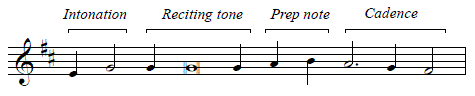
The two-note intonation is distinctive, and that second note is usually accented. If the text starts with two unaccented syllables, the initial quarter note can be repeated; if the text starts in an accented syllable, the initial quarter note can be deleted.
The reciting tone here doesn’t have an accent of its own. (To be honest, we could have said that the reciting tone starts with the whole note, but when writing down the reciting tone it generally consists of a quarter note, a double whole note with lines on either side, and a final quarter note. So splitting it up this way is at l east consistent).
There are two prep notes so signal the start of the cadence. The first can be accented or not, as the text dictates, but the last is unaccented. Slur them together if the syllable before the cadence is accented.
Finally, the cadence is slightly jazzier – an elongated or “dotted” half note, a quarter note, and half note. It begins with an accent, and so we will generally assign the syllable we are calling the lia there. Switching between the two kind of cadential rhythms keeps them distinct.
Now. we just need to repeat the A and B phrases. But when the A phrase comes around again, we don’t need that distinctive beginning to identify the melody, so we use this simpler version:

The same comments above apply! And when we finally come to the end of the troparion, here is the melody we use for the conclusion:
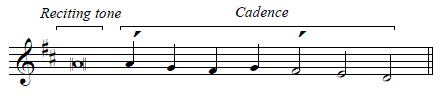
This time, there is no intonation, and we start immediately on the reciting tone. When the congregation hears that higher note at the beginning of a new phrase, they know that are into the home stretch.
This time, the cadence has TWO accents: one begins a four quarter-note pattern, and the other begins a three half-note pattern. (This is a VERY common idiom in prostopinije!) In the four-note part, accents can fall on 1 and 3, but not 2 and 4, so notes may be slurred together as needed. In effect, the congregation will be listening, perhaps without realizing it, for the accented word at which the cantor launches into the cadence; from that point, it is usually easy, even automatic, to guess where he or she will put the remaining accents, and sing accordingly.
Some sample troparia in Tone 4
The troparion melodies we looked at earlier had a handful of examplars in the Divine Liturgies book, while the Tone 4 troparion melody as 38! (You can see them and listen to recordings here.) Let’s look at some particular examples.
Here is the troparion of Saint Nicholas (December 6), wonder-working archbishop of Myra in Lycia (modern Turkey):

This text fits the pattern perfectly, and this troparion is also used as the common troparion for saintly bishops. Notice in particular the regular pattern of accents in the last phrase, with accents on notes 1 and 3 of the four-quarter-note portion of the cadence:
Intercéde with Chríst our Gód to sáve our sóuls.
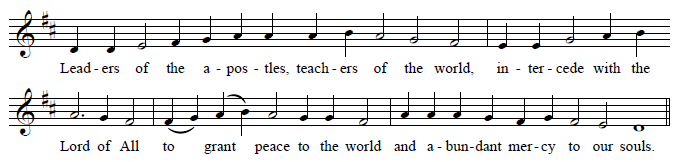
Most of the Tone 4 troparia in the Divine Liturgies book can easily be sung as written. Here is one that does throw cantors just a bit, the troparion for Saints Peter and Paul (June 29):

The two consecutive slurs are less than optimal, and then the first word on the reciting tone is “of”, leaving the key word “apostles” to show up in the middle of the line. Also, after the build-up, the long bit on the reciting tone in the last phrase almost gets lost. So we might sing the troparion this way instead:
Here is another example of a Tone 4 troparion that might stand just a little improvement. This is the pre-festive troparion for the Entrance of the Theotokos, sung on November 20:

I am looking at two points in particular. The opening notes are awkward, since the accent on TODAY falls on the faster quarter notes, and the text on the reciting tone is rather long, highlighting Anna; it almost feels like the second phrase should deliver a contrast by speaking of someone else, perhaps her husband Joachim or their daughter, the Theotokos. And at the end of the third line of music, we sing a long three-note slur over the word “Lord.” Not only is it rare in prostopinije to end with a slur like this, but the more important word here is “Temple” – since the Theotokos as temple of God is the concluding thought.
What is we were, instead, to sing it like this?
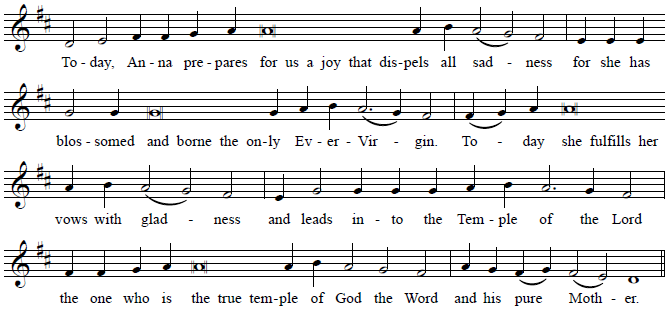
Now we have an emphasis on the prefeast (“Anna prepares … for she has blossomed…”). Also, in the final phrase, instead of opening with a slur on “the”, we emphasize that Mary IS the true temple.
Again, I am NOT advocating anyone change the versions in the Divine Liturgies book, but a cantor can learn to sing any version better by looking into it with care, and considering the different ways it might be sung.