Tomorrow, the third Sunday after Pentecost, we begin the second week of the cycle of eight tones. Today we’re going to take a quick look at the Tone 2 prokeimenon and Alleluia melody.
And if you’re not sure what prokeimena and Alleluia are, check out last week’s post!
The Tone 2 prokeimenon melody in the 1906 Prostopinije
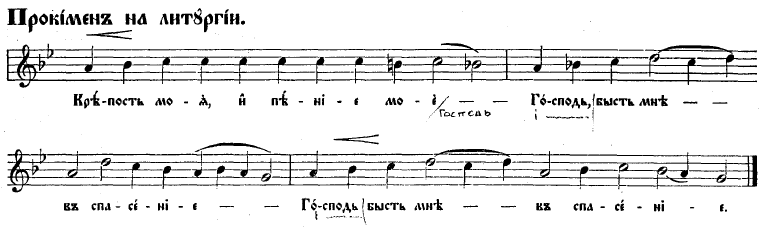
Last time, we mentioned that our basic collection of Carpathian chant or prostopinije in Church Slavonic, the Tserkovnoje Prostopinije of Bokšai and Malinič, provides FOUR examples of the prokeimenon melody in each tone. Here is the Tone 2 prokeimenon melody when it is used for singing “Holy is the Lord our God” after the canon at Sunday Matins:

Here the tonic note or do is on the middle line, as it is in most of the music in the 1906 Prostopinije; this made it easier to check against the earlier collections of Slavic chant in Kievan or square notation, which always had the tonic on the middle line of a 5-line staff.
So the melody begins ti… do… re.. and then drops down by a HALF step – not all the way back to do, but to the unstable pitch we call di in solfege singing. Then it goes back up to re and hangs there for a second, before concluding the first phrase on do. This particular pattern – re di re do – is not uncommon in prostopinije, and is a way of putting off a conclusion by adding a brief moment of tension, then immediately resolving it.
(The sequence of notes re di re also appeared in the Tone 1 prokeimenon melody, but we had too much going on to address it there. Go back and take a look!)
The second phrase begins like the first, then goes a step higher and holds, mixing scalewise steps and jumps to end on la; and the third phrase is similar, but with a more solid concluding cadence. Remember from last time that prokeimenon melodies in prostopinije almost always have three phrases, corresponding to the three parts of the Alleluia.
Here are the Sunday prokeimenon and Alleluia from the 1906 Prostopinije:

You can listen to the prokeimenon here:
If you compare the recording of the prokeimenon (which was made in 1969) you can see a change from the written music in 1906: the word “Hospod” (Lord) has been moved from the beginning of the second phrase back to the end of the first. In fact, whoever owned the copy of the 1906 Prostopinije from which these scans were made has pencilled in the same change.
The Tone 2 prokeimenon in English
You may recall from last time that the first official settings in English of the Sunday prokeimena and Alleluia in the 1970 collection Byzantine Liturgical Chant were somewhat abbreviated compared to the Slavonic. Here they are in Tone 2:
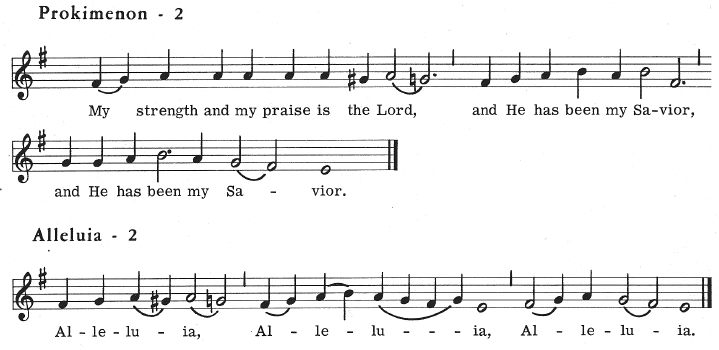
As with Tone 1, not only do these two settings leave out a good bit of the Slavonic, but after the first phrase, the two are noticeably different.
Around 2001, the Inter-Eparchial Music Commission prepared a set of music that was VERY faithful to the Slavonic, but approval for them ran into problems due to some repeated notes which just didn’t seem to work well in English (since English texts are generally so much shorter):

Here is the final version that was included in the 2006 Divine Liturgies book:


As you can hear in the recordings, moving between to prokeimenon or Alleluia and the psalm verses is not difficult. From the end of the prokeimenon, go UP a minor third (la to do) to start the psalm verse, and at the end drop a half step (do to ti) to repeat the prokeimenon; and the same for the Alleluia.
Here are the “cheat sheets” for the Tone 2 prokeimenon melody in prostopinije:


These show both the re di re do sequence, and the relationship between the prokeimenon or Alleluia and their psalm verse(s).
The prokeimenon for Thanksgiving Day
Although there are several Tone 2 prokeimena in the Presanctified Book, the anointing of the sick, and other services, there is only one additional one in the Divine Liturgies book, namely the one for Thanksgiving Day (DL 272):

With an eye to both understanding the chant and improving our use of it in English, one MGHT sing “A thanks-” on the first two notes, instead of slurring them together, so that the accent at the start of the reciting tone falls squarely on “thanksGIVing”, as we normally pronounce it.
Also, I mentioned last time that slurring a half note to a quarter sometimes causes problems, so one might sing “the” on two slurred quarter notes, with “on” having just the half note. (In both the Sunday prokeimenon and the Alleluia, those two quarter notes go together.) The goal here is not so much to change anything, as to make cantors aware of the different ways the melodies might be used to set different texts, so that they can sing whatever is written accurately.